Searching for the best country for dental implants gets two different answers depending on what a UK patient actually values. If price alone decides, the cheapest figures appear in Mexico and Turkey. If a structured pathway with regulated aftercare on UK soil matters, the shortlist tightens to three or four destinations. This guide compares seven countries against the variables that matter for British patients in 2026: total cost in pounds sterling, flight access from UK airports, accreditation framework, English fluency at clinical level, and the often-ignored question of who looks after you once you land back home.
You’ll see a like-for-like comparison table, country-by-country profiles for closer European destinations and long-haul alternatives, a transparent decision matrix to test your own situation against, and a clear explanation of why the country choice is only one third of the decision. For the broader patient journey from quote to UK aftercare, see our complete dental treatment abroad UK guide.
Why “Best Country” Is the Wrong Question on Its Own
Dental tourism is no longer a niche category. The global market reached roughly $7-8 billion by the mid-2020s, with the UK among the largest source markets and the British Dental Association reporting that 94% of UK dentists have now examined patients treated overseas.
The phrase “best country” frames the decision as if geography were the answer. However, it isn’t. A 92% implant survival rate sits inside an aftercare pathway, not inside a passport stamp. In reality, three variables decide whether the best country for dental implants for a given UK patient ends up being a positive choice:
- The clinic itself: surgeon credentials, accreditation, materials, case volume.
- The treatment match: a country strong on veneer aesthetics may not be the same country strong on zygomatic implants.
- The aftercare pathway once you land back home: whether warranty enforcement, 6-month review, and complication management have a UK-based clinical home or rely on a return flight.
The country comparison below is therefore step one of a longer decision. Specifically, it narrows the field; it does not finish the choice for you.
7-Country Comparison Table at a Glance
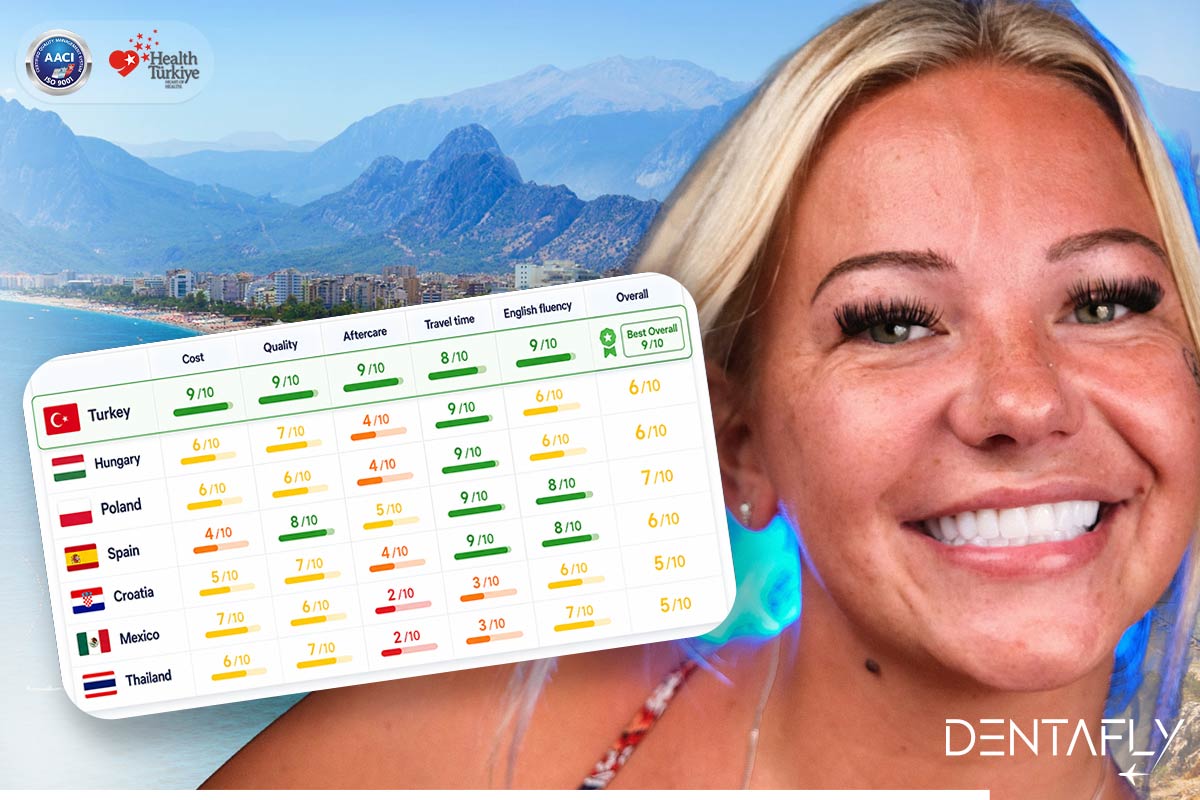
| Country | Flight from UK | Single implant + crown | All-on-4 per arch | Regulatory framework | UK aftercare option |
|---|---|---|---|---|---|
| Turkey (Antalya, Istanbul) | ~4 hours | £450-£950 | £4,500-£5,800 | Turkish Dental Association + AACI international accreditation at top clinics | Yes (Dentafly NW9 8SN, GDC-registered) |
| Hungary (Budapest, Sopron) | ~2.5 hours | £600-£1,100 | £5,200-£6,800 | EU regulatory framework + Hungarian Medical Chamber | Rarely structured |
| Poland (Krakow, Warsaw) | ~2.5 hours | £550-£1,000 | £5,000-£6,500 | EU regulatory framework + Polish Chamber of Physicians and Dentists | Rarely structured |
| Spain (Marbella, Barcelona) | ~2.5 hours | £900-£1,400 | £7,500-£9,500 | EU regulatory framework + Spanish General Council of Dentists | Some UK referral networks |
| Croatia (Zagreb, Split) | ~2.5 hours | £750-£1,200 | £6,000-£7,800 | EU regulatory framework (member since 2013) | Rarely structured |
| Mexico (Cancun, Los Algodones) | ~11+ hours (multi-stop) | £400-£700 | £3,800-£5,200 | Mexican Dental Association; quality variable outside major clinics | Not structured for UK patients |
| Thailand (Bangkok, Phuket) | ~11-12 hours | £700-£1,200 | £5,000-£6,500 | JCI-accredited hospitals + Dental Council of Thailand | Not structured for UK patients |
| UK private baseline | n/a | £2,400-£3,200 | £14,000-£18,000 | GDC + CQC oversight | Built-in |
Read across one row at a time rather than searching for the cheapest column. For instance, a Mexican price tag looks attractive until you add £900-£1,400 of return flights and 22 hours of travel time. Similarly, a Spanish quote feels reassuringly European until you compare it to a Turkish quote at half the price with comparable accreditation. As a result, each row has its own logic; the country profiles below explain when each one makes sense in the search for the best country for dental implants.
Closer-to-UK European Destinations (5 Countries)
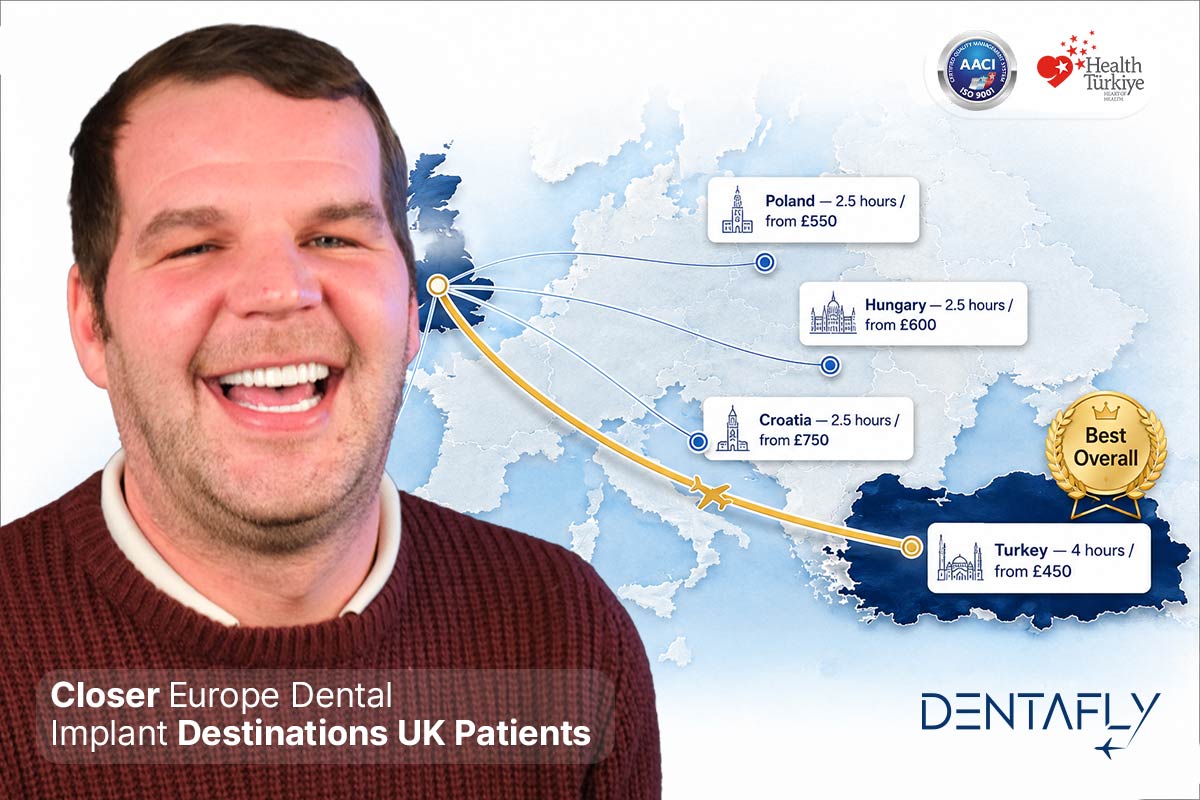
These five destinations cover roughly 90% of UK dental tourism volume. All sit within a single short-haul flight of London, Manchester, Birmingham, Edinburgh, or Glasgow. While the differences between them are real, they are smaller than the differences with long-haul alternatives.
🇹🇷 Turkey
Turkey has become the dominant European destination for UK dental patients over the past five years. Antalya and Istanbul both offer high-volume implant centres, with leading clinics holding AACI international accreditation and using the same implant systems found in UK private practice (Straumann, Nobel Biocare, Medentika). English fluency at clinical level is standard at top facilities. Direct flights land at Antalya International (AYT) in four hours, and prices on both single implants and full-arch cases run 60-80% below UK private rates.
The feature that elevates Turkey above other European options for UK patients specifically is the emergence of hybrid UK-Antalya clinic models. Dentafly operates a London NW9 8SN aftercare clinic with a GDC-registered team, meaning the 6-month review, warranty enforcement, and complication management happen on UK soil.
🇭🇺 Hungary
Hungary built its dental tourism reputation in the 1990s when Austrian and German patients began crossing the border to Sopron for cheaper, regulated care. The model has since matured: Budapest now hosts dozens of dedicated international patient clinics, and the EU regulatory framework provides a baseline of patient protection familiar to UK travellers. Flights from London run around 2.5 hours, with savings of 55-70% against UK private rates.
Honest limitations: English fluency varies more than in Turkey or Croatia, particularly in smaller Sopron border clinics; aftercare typically ends at the clinic door with no structured UK follow-up; and prices on premium implant brands tend to sit 25-35% above equivalent Turkish quotes. For a focused side-by-side, see our Turkey vs Hungary comparison.
🇵🇱 Poland
Poland is Hungary’s main competitor for short-haul European dental tourism from the UK. Krakow and Warsaw both host well-equipped private clinics, with prices sitting slightly below Hungarian averages. The EU regulatory environment is the same, and direct flights from major UK cities are plentiful, often under £150 return outside school holidays.
Where Poland tends to underperform Turkey is in clinical case volume for complex full-arch and zygomatic cases, simply because individual surgeons see fewer per year. For single implants, multi-unit cases, and routine prosthetic work, Polish clinics are competitive on both price and quality. The aftercare gap on the UK side is identical to Hungary’s: very few Polish clinics have a structured UK follow-up arrangement.
🇪🇸 Spain
Spain occupies a different position from the other four European destinations on this list. Prices are the highest in this group, often only 30-45% below UK private rates rather than the 60-70% seen in Turkey, Hungary, or Poland. What Spain offers in return is geographic familiarity for UK patients, particularly the large British expat population in Costa del Sol, Costa Blanca, and the Balearic Islands.
Marbella and Barcelona host high-end private clinics with strong English fluency, modern digital workflows, and EU-level patient protections. The premium price reflects Spanish living costs and salary structures rather than superior clinical outcomes; survival rates at top Turkish, Hungarian, and Spanish clinics are statistically indistinguishable in published implant data.
🇭🇷 Croatia
Croatia is the quieter European entrant on this list and deserves more attention than it usually receives. Zagreb and Split host private clinics with strong English fluency (Croatia has unusually high English proficiency in healthcare compared to regional neighbours), EU regulatory protections since 2013, and prices between Hungarian and Spanish levels.
The main limitation is volume: the dental tourism sector is smaller than Turkey’s or Hungary’s, which means fewer dedicated international patient coordinators, less mature pre-flight CBCT workflows, and longer waiting lists at the most reputable clinics. Aftercare, as with most European destinations, is not structured on the UK side.
Long-Haul Alternatives: Mexico and Thailand
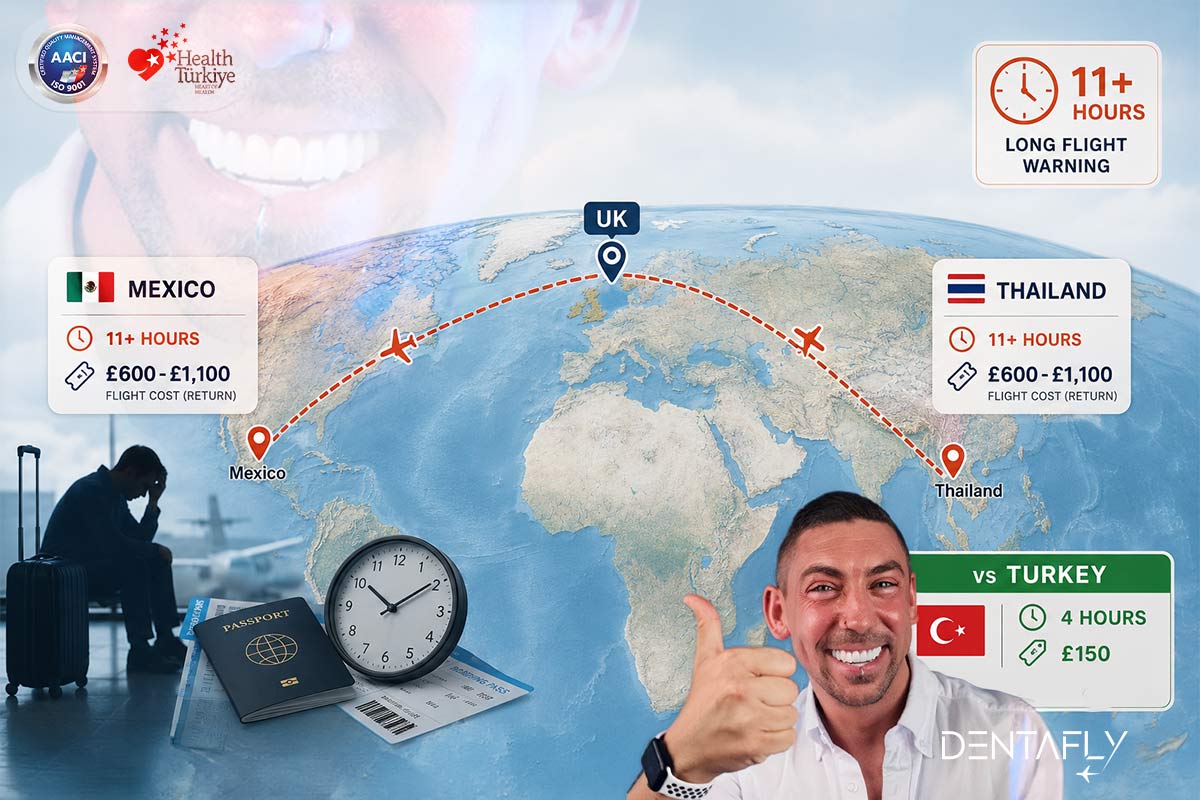
Mexico and Thailand appear regularly in global “best country for dental implants” lists because they offer competitive prices and developed medical tourism infrastructure. Both deserve fair coverage; however, both are also a poor fit for most UK patients for reasons that have nothing to do with clinical quality and everything to do with geography.
🇲🇽 Mexico
Mexico is the world’s largest dental tourism market by volume, driven almost entirely by US patients crossing the border at Los Algodones, Tijuana, and Nuevo Progreso, with Cancun serving the US East Coast. Top clinics deliver competent implant work at prices roughly 70-80% below US averages.
For UK patients, the maths shifts unfavourably. Return flights from London to Cancun typically cost £600-£1,000, jet lag adds a recovery dimension absent from European trips, and the country has no structured UK aftercare network. The headline price advantage over Turkey or Poland disappears once travel costs are added. See our Turkey vs Mexico comparison for the UK-specific cost analysis.
🇹🇭 Thailand
Thailand built its medical tourism reputation through hospital groups like Bumrungrad and Bangkok Hospital, both JCI-accredited. Dental implant capacity at top Bangkok and Phuket clinics is genuinely strong, with modern digital workflows, premium implant brands, and English fluency higher than in much of South-East Asia.
The challenge for UK patients matches Mexico: an 11-12 hour flight, time zone shift of 6-7 hours, and £700-£1,100 return airfare convert a competitive implant price into a total trip cost that often matches or exceeds Turkish equivalents.
8 Criteria for Choosing the Best Country for Dental Implants
The country comparison above is the surface layer. Beneath it, the eight criteria below are what separates a positive outcome from a problematic one within any given country. In short, choosing the best country for dental implants is only step one; the eight variables below determine whether step two ends well.
Clinical and Surgical Criteria (1-5)
The first five criteria address the surgical safety and quality of the procedure itself. Specifically, these are the questions that determine whether the implant integrates well and lasts.
| Criterion | What to ask | Why it matters for UK patients specifically |
|---|---|---|
| 1. Surgeon credentials | Named lead surgeon, DDS/MSc verification, professional registration | Avoids the unverified-team risk that drives most BDA-reported complications |
| 2. Accreditation | AACI, JCI, or national equivalent for the facility | Confirms patient-safety auditing equivalent to UK CQC standards |
| 3. Implant brand | Straumann, Nobel Biocare, Medentika named explicitly in quote | Determines warranty terms and UK clinician familiarity for any later work |
| 4. CBCT and digital workflow | 3D imaging, intraoral scan, guided surgery | Reduces placement-error risk that drives revision needs |
| 5. Anaesthesiologist availability | On-site supervision for complex or medically compromised cases | Rare in dental tourism; essential for cardiovascular or diabetic patients |
Communication and Long-Term Criteria (6-8)
The last three criteria address what happens before, during, and after the surgical day. Notably, these are the variables that most often distinguish a positive UK patient experience from a complicated one.
| Criterion | What to ask | Why it matters for UK patients specifically |
|---|---|---|
| 6. English fluency | Clinical staff (not just coordinator) speak English | Misunderstood post-op instructions are a major complication driver |
| 7. UK aftercare | Structured 6-month review on UK soil with GDC-registered clinician | The single most predictive variable for long-term outcome |
| 8. Warranty terms | Written, jurisdiction specified, enforcement mechanism clear | Determines what happens 3-5 years later if a complication appears |
Why UK Aftercare Is the Real Deciding Factor
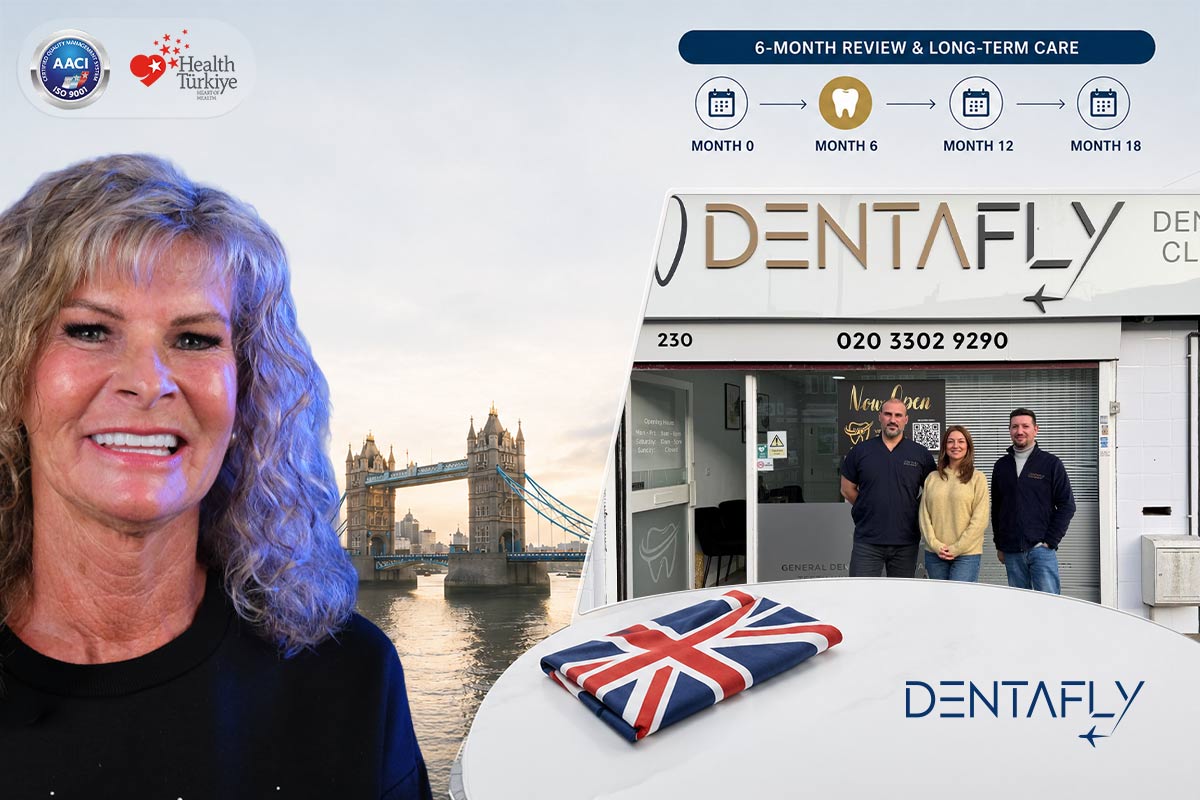
Implants don’t fail at six months from placement quality. Instead, they fail two to five years later from peri-implant inflammation that started as reversible mucositis and progressed because nobody caught it. A peri-implant mucositis appointment costs a maintenance visit. By contrast, a peri-implantitis case with established bone loss costs a revision surgery and sometimes the implant itself.
This is why country choice and clinic choice both matter less than the aftercare arrangement. In other words, the best country for dental implants for UK patients is often defined less by where the surgery happens than by where the follow-up happens. A patient who travels to Turkey with a hybrid UK-Antalya clinic that includes a structured 6-month London review is better protected than a patient who travels to Spain or Hungary with no UK follow-up.
Dentafly’s UK aftercare programme at London NW9 8SN includes a 6-month review with bleeding-on-probing scores at every implant site, probing pocket depth measurement, baseline periapical radiograph, oral hygiene technique review, and warranty record activation. The clinic operates under GDC oversight with UK-registered clinicians. Indeed, this is what no Turkey-only, Hungary-only, or Spain-only clinic can match for UK patients.
Best Country for Dental Implants: UK Patient Decision Matrix
Use the matrix below to test your own situation against the seven countries before requesting quotes. Specifically, the best country for dental implants depends on which of these priorities matters most to you. The output is a shortlist, not a final answer.
| Your priority | Best country fit | Why |
|---|---|---|
| Lowest total cost including travel | Turkey | 4-hour flight, lowest implant prices among accredited European options |
| Shortest flight time | Hungary, Poland, Spain, Croatia | All 2.5 hours from major UK airports |
| Strongest UK aftercare pathway | Turkey (Dentafly NW9 8SN model) | Only destination with a dedicated UK clinic for follow-up |
| Complex full-arch or zygomatic case | Turkey | Highest case volume and on-site anaesthesiologist availability |
| EU regulatory familiarity | Hungary, Poland, Spain, Croatia | All four operate under EU healthcare framework |
| UK expat already abroad | Spain (Costa del Sol, Marbella) | Geographic continuity with existing residence |
| Treatment combined with holiday | Thailand, Mexico | Long-haul makes sense only with significant holiday overlap |
| Diabetic or cardiovascular patient | Turkey (Dentafly) | On-site anaesthesiologist, see our diabetes implant protocol |
Best Country for Dental Implants Cost Comparison and UK Finance
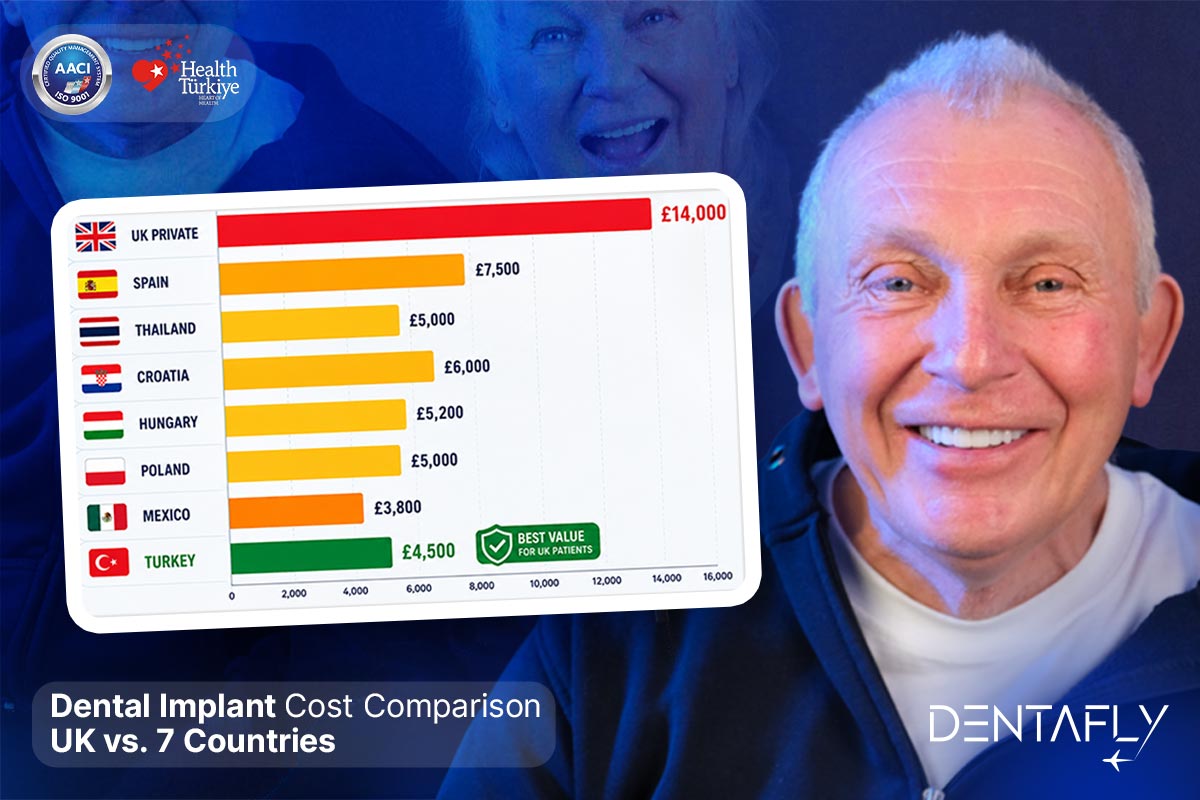
The figures below assume comparable premium-brand implants, identical prosthetic specifications, and accredited clinics within each country. Notably, this is treatment cost only; flights are listed in the lower row.
| Treatment | UK private | Turkey | Hungary | Poland | Spain | Croatia | Mexico | Thailand |
|---|---|---|---|---|---|---|---|---|
| Single implant + zirconia crown | £2,400 | £450-£950 | £600-£1,100 | £550-£1,000 | £900-£1,400 | £750-£1,200 | £400-£700 | £700-£1,200 |
| All-on-4 per arch | £14,000 | £4,500 | £5,200-£6,800 | £5,000-£6,500 | £7,500-£9,500 | £6,000-£7,800 | £3,800-£5,200 | £5,000-£6,500 |
| All-on-6 per arch | £18,000 | £5,800 | £6,800-£8,400 | £6,500-£8,000 | £9,500-£12,000 | £7,500-£9,500 | £4,800-£6,500 | £6,500-£8,500 |
| Typical return flights from UK | n/a | £120-£220 | £70-£180 | £60-£160 | £80-£200 | £100-£220 | £600-£1,000 | £700-£1,100 |
Two patterns are visible. First, Turkey offers the largest savings on full-arch cases among accredited European destinations, often £700-£3,000 cheaper per arch than Hungary, Poland, or Croatia. Second, the headline implant price advantage of Mexico and Thailand evaporates once UK return flights are added. For a deeper analysis see our implant cost breakdown.
Flexible Dental Finance: From £60.72/mo
UK patients can spread dental implant treatment across 6-60 months with our partner dental finance options. The structured payment plans below are designed for treatments above £1,500 and include no-deposit arrangements for credit-approved applicants.



Zirconium Crowns 10 Upper 10 Bottom
Zirconium Crowns 10+10
Apply for Dental Finance
e-max Veneers 8+8
e-max Veneers 8+8
Apply for Dental Finance
All-on-4 Cad/Cam
Apply for Dental Finance
All-on-6 Cad/Cam
Apply for Dental Finance
Composite Bonding 10+10
Apply for Dental Finance
Get Your All-Inclusive Quote
Send your panoramic X-ray and most recent dental records and we’ll return a detailed, itemised treatment plan within 24 hours, in pounds sterling, with no obligation to book.
Get Your Free QuoteA Surgeon’s Perspective on Choosing a Country
The country comparison above is built on price tables and flight schedules. However, the patient-side experience of choosing one mixes practical logistics with the trust required to place your health in foreign hands. We asked Dt. Burak Gokdeniz to share how he thinks about that side of the decision.
After gaining extensive international experience at various clinics in Dubai and Qatar, I continue to welcome patients from all around the world in my current role at Dentafly, including a large number of UK patients each month. Connecting with people from diverse cultures, understanding their unique expectations, and touching their lives with a flawless smile is an invaluable passion of mine. The country a patient chooses is the start of that conversation, not the end of it.
Real UK Patient Story
Malcolm, a UK patient from North Wales, researched dental implant options on Google before choosing Turkey. His full-mouth case (five implants in each jaw on a titanium bar) was completed across two visits with recovery in North Wales between phases. His unedited interview covers the country-choice question directly.
Frequently Asked Questions
Country Choice Questions
Which country is best for dental implants for UK patients?
Is it cheaper to get dental implants in Mexico or Turkey?
Are dental implants in Hungary as good as in Turkey?
What is the safest country for dental implants?
Cost and Finance Questions
How long do dental implants last when you get them abroad?
Can I get my dental implants done abroad on UK finance?
Is dental tourism really worth it from the UK in 2026?
Aftercare and Risk Questions
What happens if my implant fails after I return to the UK?
UK Aftercare for Patients Treated Abroad
Every Dentafly implant patient receives a structured aftercare review at our London clinic six months after treatment. The visit covers bleeding-on-probing scores at each implant site, probing pocket depth measurement, baseline periapical radiograph, oral hygiene technique reinforcement, and warranty record activation on the UK side.
The NW9 8SN clinic is led by Dt. Merve Sezer Topcu, our UK Aftercare coordinator, with periodontal review available from Assoc. Prof. Dt. Gülen Kamak when escalation is required. All UK-based clinical work is performed by GDC-registered clinicians.
- 📍 230 Church Lane, London NW9 8SN
- 📞 +44 20 3302 9290
- ✉️ [email protected]
- 🕐 Mon-Fri 9:00-18:00, Sat 10:00-17:00
- 🚇 12 min from Colindale (Northern Line)
- 🚗 8 min from M1 Junction 2, free parking on-site
Related Guides
- Dental Treatment Abroad UK — Complete Patient Guide
- Dental Holiday Packages in Turkey
- Why You Should Go Abroad for New Teeth
- Top 10 Dental Clinics in the World
- 10 Top Tips for Dental Treatments in Turkey
- Dental Implants Turkey
- Dental Implants Cost Breakdown
- Turkey vs Hungary Implants Comparison
- Turkey vs Mexico Implants Comparison
- UK Aftercare for Dental Implants at London NW9 8SN