If you live with diabetes and you’ve been told implants are too risky, the answer is more nuanced than that. Dental implants with diabetes are not only possible; when HbA1c is stable and the surgical pathway is adapted properly, well-controlled diabetic patients see survival rates between 92.3% and 92.4%, very close to non-diabetic outcomes. What changes is the protocol, not the eligibility.
This guide walks you through every phase: what to do before you fly, the day-by-day treatment timeline in Antalya, recovery markers to track, and how UK aftercare at our London NW9 8SN clinic protects long-term integration. It is written for Type 1, Type 2, and well-managed gestational-history patients planning treatment abroad. For broader implant context, see our complete dental implants in Turkey guide.
Eligibility at a Glance: Who Can and Can’t Proceed
There is no single yes or no answer for every diabetic patient. Instead, three variables decide treatment readiness:
- Glycaemic stability: your HbA1c trend across the last 3-6 months, not just a single reading
- Periodontal status: whether existing gum inflammation is controlled before surgery
- Systemic health context: cardiovascular comorbidities, smoking, medications such as bisphosphonates
If all three sit in a manageable range, you are a candidate. If one is unstable, treatment is deferred rather than denied, and we tell you that honestly during your free assessment.
| Recent HbA1c | Control category | Implant pathway |
|---|---|---|
| < 6.5% | Tight control | Standard protocol, conventional timeline |
| 6.5% – 7.9% | Good to moderate | Standard protocol with enhanced antiseptic rinses |
| 8.0% – 9.9% | Moderate | Staged loading, longer healing window, GP coordination |
| ≥ 10.0% | Poor | Surgery deferred; stabilisation plan first |
Phase 1: Pre-Treatment Preparation (4-8 Weeks Before Flight)
The single biggest predictor of a smooth implant journey is what you do before you fly, not what happens in the chair.
Step 1.1: Confirm a recent HbA1c reading
Request a fasting HbA1c blood test through your GP. If your last reading is older than 90 days, repeat it. We need the trend, ideally with two or three readings spaced across the last six months. Send the lab report through your Dentafly patient coordinator.
Step 1.2: Coordinate with your diabetes team
If your control sits in the 8-9.9% bracket, your GP, diabetic nurse, or endocrinologist becomes part of the treatment plan. We share the proposed surgical date with them in writing and ask three questions:
- Is your medication regimen stable, or under recent adjustment?
- Are there cardiovascular contraindications to local anaesthesia or short sedation?
- Is there a target HbA1c they want to see before clearance?
This conversation usually takes 10 minutes between coordinators. It is the step most clinics skip and the one that prevents most complications.
Step 1.3: Periodontal stabilisation
Diabetes raises periodontitis risk roughly threefold, and active gum disease is the strongest predictor of peri-implantitis later. If your last hygienist visit revealed bleeding on probing, pocket depths over 4 mm, or generalised inflammation, you treat that first. Typical pathway:
- Deep cleaning (full-mouth debridement) with your UK hygienist or our London team
- Two-week reassessment
- Surgery scheduled only after bleeding scores drop below 20%
Step 1.4: Smoking and lifestyle
Smoking combined with diabetes raises implant failure risk multiplicatively, not additively. We ask patients to stop smoking at least 4 weeks before surgery and through the first 8 weeks of healing. Alcohol is restricted in the 72 hours pre- and post-op because it interferes with antiseptic mouth rinse action.
Phase 2: Day-by-Day Treatment Timeline in Antalya
Day 0: Travel and arrival
You land at Antalya International (AYT), our driver meets you, and you check into your 4 or 5-star partner hotel. No clinical work on day 0. Hydration, rest, and a light low-glycaemic dinner.
Day 1: Consultation, CBCT, point-of-care HbA1c
Three things happen in roughly 90 minutes:
- CBCT 3D scan of upper and lower jaws, slice-by-slice review of bone height, density, and proximity to vital structures (mandibular nerve, maxillary sinus, mental foramen).
- Point-of-care HbA1c capillary test: a finger-prick capillary blood sample gives us your current reading inside 10 minutes. This is the moment we either confirm the surgical date or postpone if your control has drifted since your home blood test.
- Surgical plan review with Dr. Soner Arikan, our lead maxillofacial surgeon. Implant brand (Straumann, Nobel Biocare, or Medentika depending on case), placement angle, abutment plan, and loading timeline are agreed in writing.
Day 2: Surgical placement
Surgery is typically same-week, sometimes same-day for single-tooth cases. The diabetic-adapted protocol differs from a standard placement in three measurable ways:
- Atraumatic flap design: minimal soft-tissue elevation to preserve vascular supply, because diabetic tissues recover blood flow more slowly.
- Antibiotic loading: a pre-operative oral antibiotic dose 1 hour before surgery, plus a 5-day post-op course rather than the 3 days standard for healthy patients.
- Anaesthesiologist on standby: for diabetic patients with cardiovascular comorbidity or for full-arch cases, our resident anaesthesiologist supervises vital signs throughout the procedure. This is rare in dental tourism, and it is the reason our complex cases are accepted by patients who were turned away elsewhere.
Surgery takes 30-90 minutes per implant. You leave the chair, rest at the hotel, and follow the antiseptic rinse schedule from that evening.
Day 3-4: Recovery monitoring and discharge
You return to the clinic the morning after surgery for a wound check, suture review, and a second HbA1c reading to confirm stress hyperglycaemia has not spiked. Most patients are cleared to fly home from day 4 onward for single or partial cases, day 6-7 for full-arch.
Phase 3: Healing and Osseointegration (Months 1-3)
This is the period that decides long-term success. In non-diabetic patients osseointegration (the direct bone-to-implant fusion first described by Brånemark in 1952) typically completes in 8-12 weeks. In diabetic patients with HbA1c above 8%, that same process can take up to 18 weeks before full stability is reached.
You manage three things at home:
3.1 Antiseptic rinse protocol
Chlorhexidine 0.12% twice daily for 14 days, then a non-alcoholic antiseptic rinse for the remainder of the healing phase. Alcohol-based rinses are avoided because they thicken the oral mucosa and may interact with metformin in some patients.
3.2 Glycaemic monitoring
Daily glucose log for the first 14 days. Surgery itself is a transient hyperglycaemic stressor, with a 1-2 mmol/L spike for 48-72 hours considered normal. Anything sustained beyond that, or above 12 mmol/L, you call your GP and copy us.
3.3 Warning signs that need a same-week response
- Persistent throbbing pain after day 4 (most patients are off paracetamol by day 3)
- Bleeding from the surgical site beyond day 2
- Mobility of the implant felt on tongue contact
- Bad taste, pus discharge, or swelling that expands rather than reduces
Phase 4: Final Restoration and Stability Verification
Around month 3 (or month 4-5 for higher HbA1c cases), you return to Antalya for two days.
4.1 Implant stability check
We use a resonance frequency analysis device, most commonly Osstell, to measure the implant’s mechanical stability quotient (ISQ). A reading above 70 ISQ indicates safe loading. Diabetic patients sometimes need a second check 2-4 weeks later if the first reading is borderline. This objective measurement replaces guesswork and protects against early loading failures.
4.2 Abutment placement and impression
Once ISQ is confirmed, the healing cap is replaced with the abutment (the connector that links implant to crown). A digital intraoral scan captures the impression. Our in-house CAD/CAM lab mills the final crown (typically zirconia or e.max) within 48 hours.
4.3 Crown fitting and occlusal review
The crown is fitted, bite is balanced, and you receive a written restoration record with implant batch numbers, brand, torque values, and a 12-month follow-up schedule.
Phase 5: UK Aftercare at London NW9 8SN
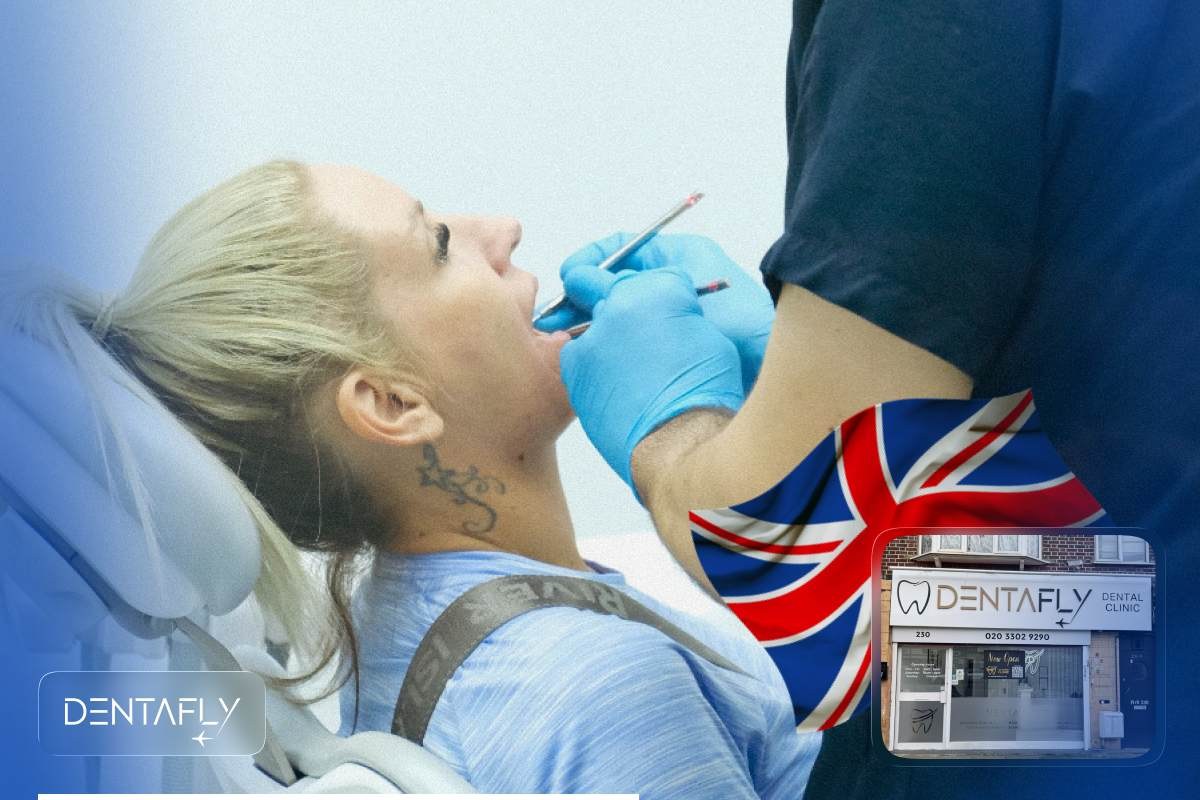
This is the phase that no Turkey-only clinic can provide and the reason Dentafly exists as a hybrid UK-Antalya operation.
Diabetic-specific 6-month monitoring
Your first UK aftercare appointment is scheduled 6 months after crown placement. We assess:
- Bleeding on probing at six sites per implant (any score above 10% triggers a maintenance plan)
- Probing pocket depth: readings above 4 mm flag early peri-implant mucositis
- Periapical radiograph to check crestal bone level versus your post-op baseline
- HbA1c update through coordination with your GP, brought into our records
If you live outside London, we coordinate with a UK-based hygienist closer to you and remain the clinical lead by remote review.
Treating early problems before they become failures
The strongest case for diabetic patients choosing Dentafly over a Turkey-only provider is exactly this point: peri-implant mucositis is reversible if caught early, and our 6-month protocol is built around catching it. Once it progresses to peri-implantitis with established bone loss, the success rate of treatment drops sharply.
Risk Modifiers: A Decision Framework by Control Level
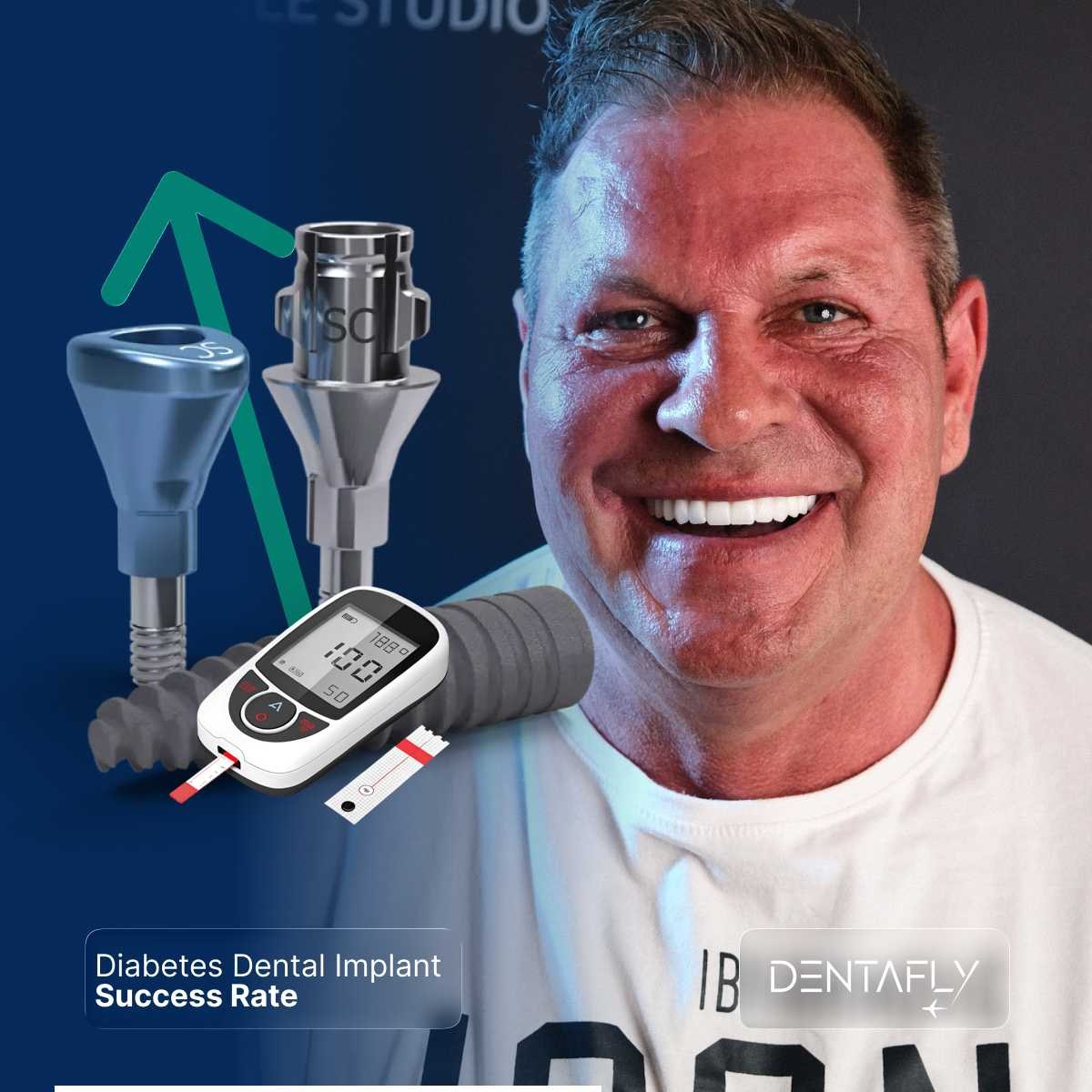
Real-world implant outcomes in diabetic populations vary widely depending on three modifiers. The table below synthesises published implant-survival data and our own internal Dentafly diabetic case audit.
| Risk profile | HbA1c | Smoking | Periodontitis history | 10-year survival |
|---|---|---|---|---|
| Excellent | < 7% | No | Controlled / none | ~94-96% |
| Good | 7-7.9% | No | Treated, stable | ~92-94% |
| Moderate | 8-8.9% | No | Active, treated pre-op | ~88-91% |
| Compromised | 8-8.9% | Yes | Active | ~78-84% |
| High-risk | ≥ 9% | Yes | Active | Surgery deferred |
Diabetic Implant Cost Breakdown and UK Finance Options
Diabetic implant cases involve the same hardware as non-diabetic cases. What you pay extra for is the longer aftercare window, the antibiotic regimen, and the optional anaesthesiologist supervision. At Dentafly these are bundled into transparent diabetic-protocol pricing.
| Treatment | Antalya price | UK private average |
|---|---|---|
| Single implant + zirconia crown (Medentika) | £450 | £2,400 |
| Single implant + zirconia crown (Straumann premium) | £950 | £3,200 |
| All-on-4 per arch | £4,500 | £14,000 |
| All-on-6 per arch | £5,800 | £18,000 |
| Anaesthesiologist supervision (optional) | £200/session | Not routinely available |
| Diabetic 6-month London aftercare review | Included | Not applicable |
Flexible Dental Finance: From £60.72/mo
UK patients can spread diabetic implant treatment across 6-60 months with our partner dental finance options. The structured payment plans below are designed for treatments above £1,500 and include no-deposit arrangements for credit-approved applicants.



Zirconium Crowns 10 Upper 10 Bottom
Zirconium Crowns 10+10
Apply for Dental Finance
e-max Veneers 8+8
e-max Veneers 8+8
Apply for Dental Finance
All-on-4 Cad/Cam
Apply for Dental Finance
All-on-6 Cad/Cam
Apply for Dental Finance
Composite Bonding 10+10
Apply for Dental Finance
Get Your Diabetic-Safe Implant Plan
Send your most recent HbA1c reading and panoramic X-ray for a written treatment plan tailored to your control profile.
Get Your Free QuoteAlternatives if Implants Aren’t Suitable Today
If your HbA1c is currently above 10% or unstable, implants are deferred, not refused. Three alternative pathways exist:
Stabilise first, treat later. A 6-month glycaemic stabilisation plan with your GP, combined with periodontal therapy. We re-test at month 6 and reassess implant candidacy. Most patients in this group eventually become eligible.
Dental bridge. A fixed bridge uses adjacent natural teeth as anchors. Practical for single missing teeth where the neighbouring teeth are already crowned or compromised. Not ideal if both adjacent teeth are healthy because preparation involves reshaping them.
Removable denture. Modern flexible-base partials and full dentures are far more comfortable than older designs. They are the right answer for patients with very poorly controlled diabetes, advanced bone loss, or financial constraints. We can transition you to an implant-supported denture later once your control improves.
Real Diabetic Patient Experiences
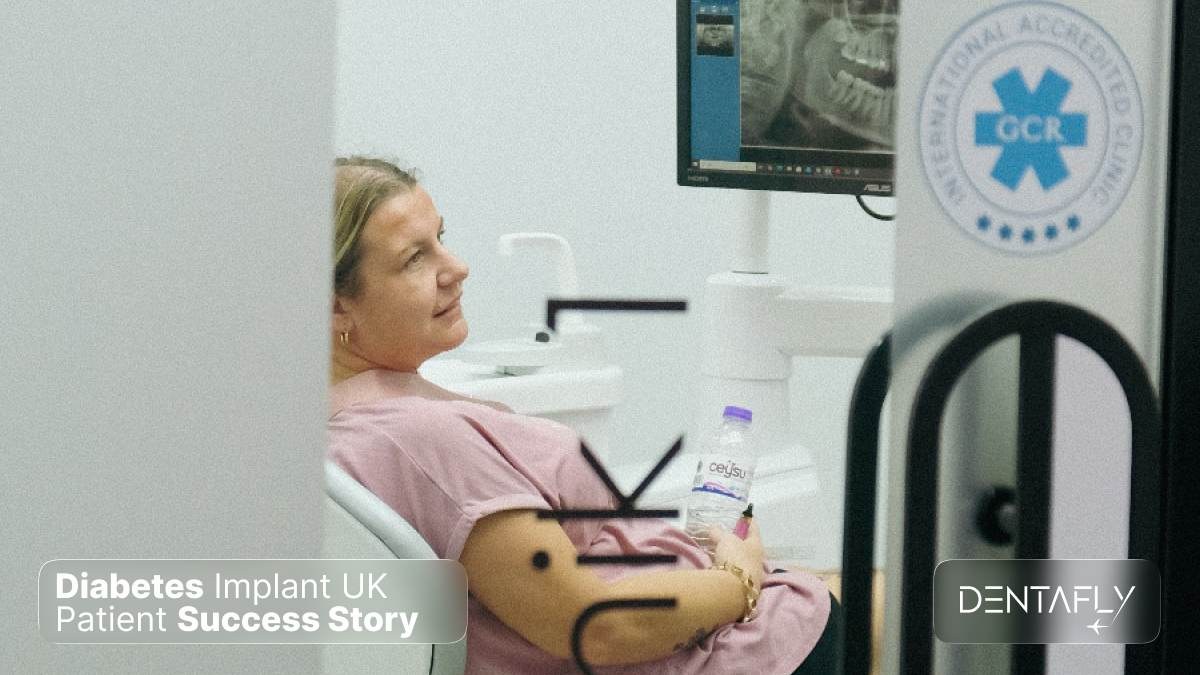
We do not publish written testimonials in clinical content. Instead, we maintain a dedicated YouTube channel with over 700 patient videos, including diabetic and complex medical cases. The unedited interviews give a fuller picture of recovery than any prose summary.
Frequently Asked Questions
Can Type 1 diabetics get dental implants in Turkey?
Does diabetes shorten how long dental implants last?
What HbA1c do I need to be cleared for surgery?
Are All-on-4 implants safe for diabetic patients?
What happens if I develop peri-implantitis after the warranty period?
Will my insulin or metformin interfere with the surgery?
UK Aftercare for Diabetic Implant Patients
Diabetic implant patients receive a structured 6-month monitoring schedule at our London clinic. The visit covers bleeding-on-probing scores at six sites per implant, probing pocket depth, periapical radiograph comparison against your post-op baseline, and HbA1c update coordination with your GP.
The NW9 8SN clinic is led by Dt. Merve Sezer Topcu, our UK Aftercare coordinator, with periodontal review available from Assoc. Prof. Dt. Gülen Kamak when escalation is needed. This is the routine that prevents peri-implant mucositis from progressing to peri-implantitis, the single biggest cause of late implant loss in diabetic patients.
- 📍 230 Church Lane, London NW9 8SN
- 📞 +44 20 3302 9290
- ✉️ [email protected]
- 🕐 Mon-Fri 9:00-18:00, Sat 10:00-17:00
- 🚇 12 min from Colindale (Northern Line)
- 🚗 8 min from M1 Junction 2, free parking on-site