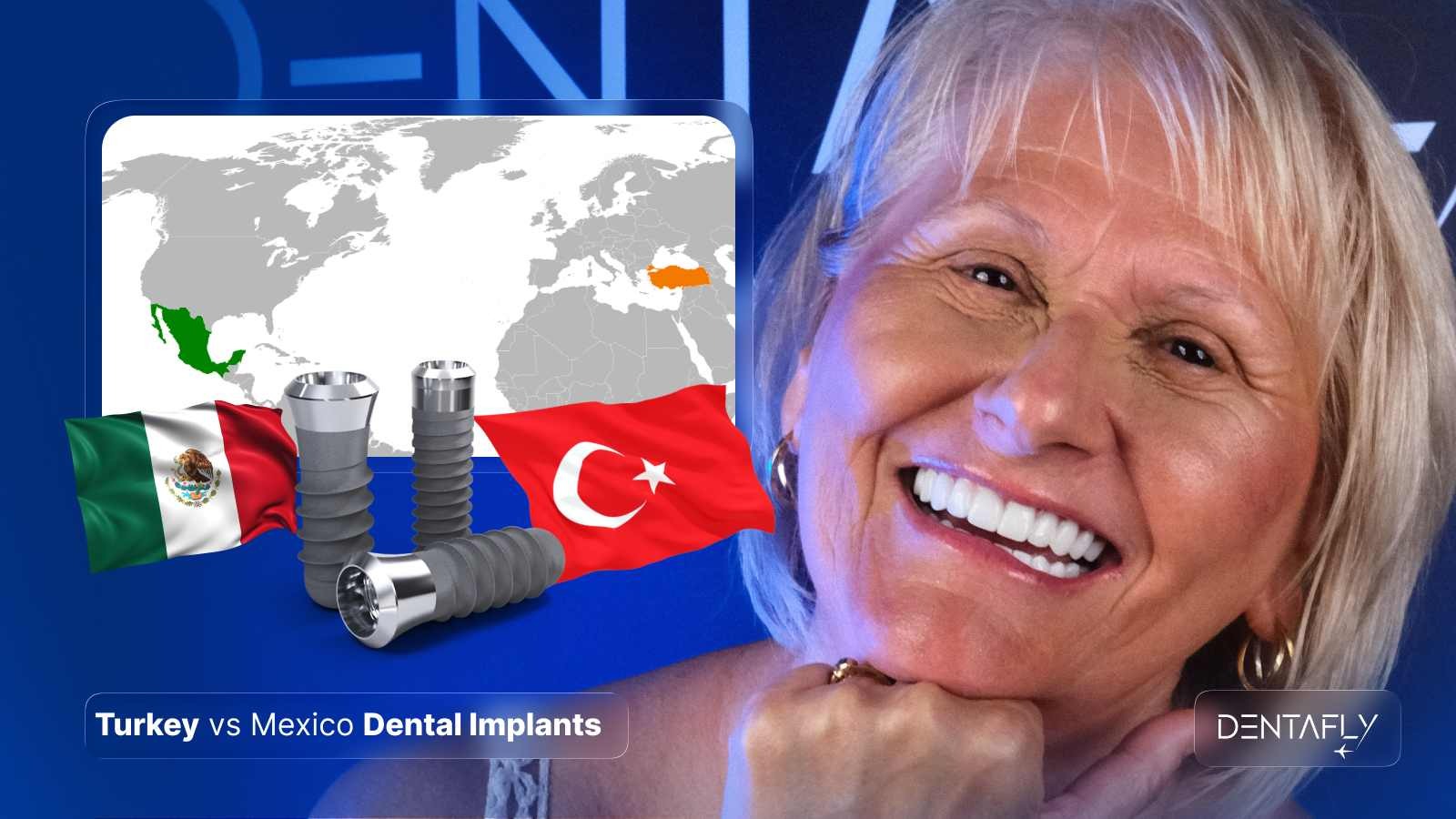
For Americans considering Turkey vs Mexico dental implants, the choice has become genuinely complex. Mexico has long been the obvious answer for US patients seeking affordable dental work — Cancun, Tijuana, and Los Algodones built their dental tourism reputations on serving Americans for decades. Turkey arrived later but moved fast, and now hundreds of thousands of US patients fly across the Atlantic for treatment that costs less than driving to Tijuana. The question is no longer whether dental tourism makes financial sense. It is which country actually delivers the best combination of cost, quality, and long-term outcomes.
This Turkey vs Mexico comparison comes from a Turkish clinic, which means it has a built-in bias. We have tried to compensate by citing independent data, acknowledging Mexico’s genuine advantages for some patient profiles, and pointing out where Mexican clinics might serve you better than Antalya. The goal is honest decision support, not marketing copy. For broader implant context, see our complete dental implants in Turkey guide. Comparing more than two destinations? Our best country for dental implants ranking covers costs, standards and travel logistics across all major hubs.
Cost Comparison: Turkey vs Mexico 2026 (USD)
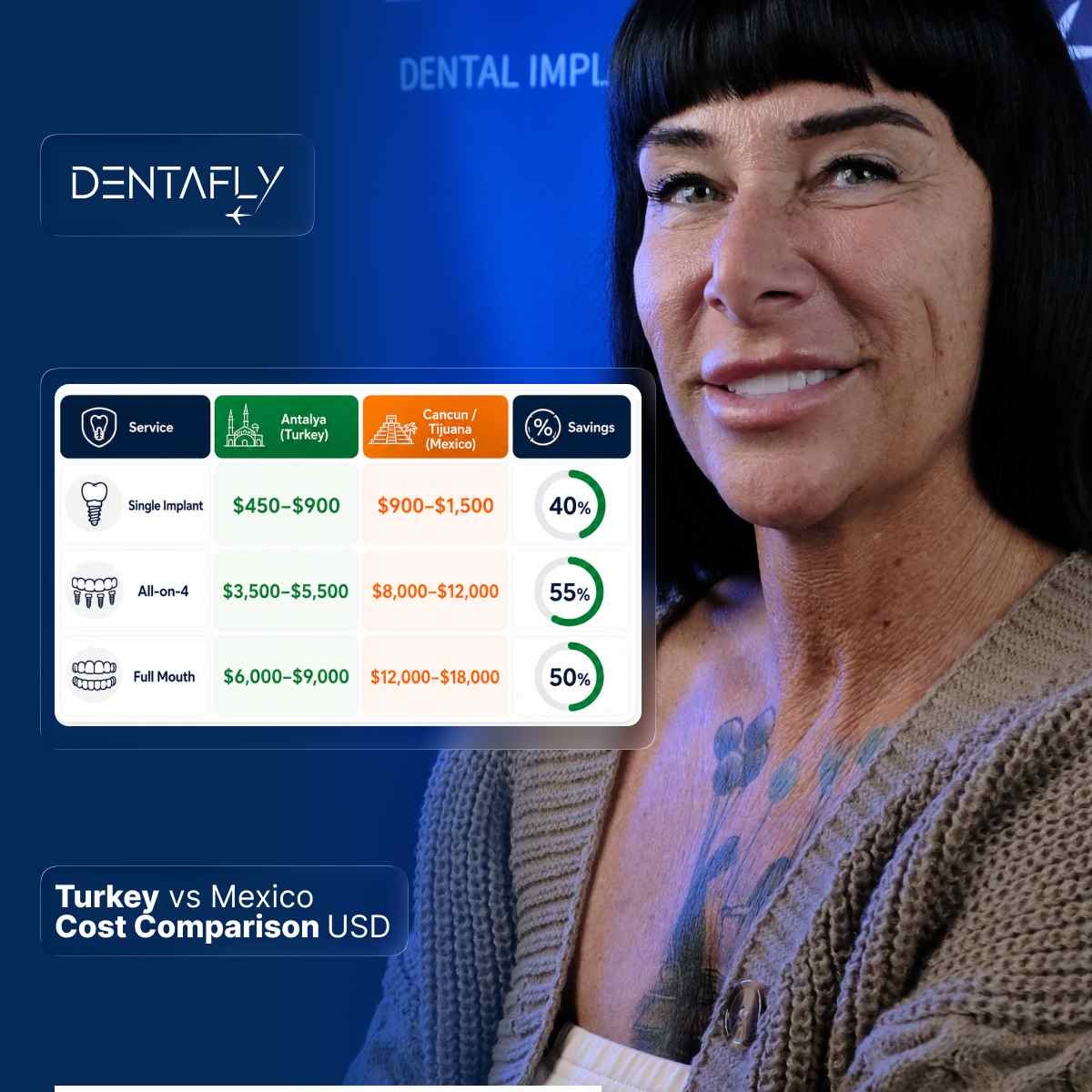
Cost is where the Turkey vs Mexico comparison gets interesting for US patients. Mexico has historically held the dental tourism cost advantage for Americans because of geographic convenience. But the underlying numbers tell a different story — Turkey now consistently undercuts Mexican dental tourism prices by 40-55% across treatment categories, even after factoring in transcontinental flights.
| Treatment | US Private (Avg) | Mexico (Cancun/Tijuana) | Dentafly Turkey | Savings |
|---|---|---|---|---|
| Single Implant + Crown | $3,500-$5,000 | $900-$1,500 | $450-$900 | 40% |
| Premium (Straumann/Nobel) | $5,000-$7,000 | $1,800-$2,500 | $1,000-$1,800 | ~40% |
| All-on-4 Per Arch | $24,000-$30,000 | $8,000-$12,000 | $3,500-$5,500 | 55% |
| All-on-6 Per Arch | $28,000-$38,000 | $10,000-$14,000 | $4,200-$6,500 | 55% |
| Full Mouth (Both Arches) | $50,000-$75,000 | $12,000-$18,000 | $6,000-$9,000 | 50% |
| Bone Graft (Sinus Lift) | $2,500-$4,000 | $1,200-$2,000 | $600-$1,100 | 50% |
| Zygomatic Implant | $15,000-$22,000 | $8,000-$12,000 | $3,200-$5,000 | 60% |
The savings on full-mouth restoration are most striking. An American patient choosing Mexico over private US practice typically saves $35,000-$55,000. Choosing Turkey instead saves an additional $4,000-$10,000 over Mexico, plus access to AACI accreditation and premium brand availability that’s less consistent at Mexican border clinics.
Importantly, both countries use the same global brands at quality clinics: Straumann, Nobel Biocare, Hiossen. Same materials including Geistlich Bio-Oss for bone grafting. The price difference reflects local economics, not clinical compromise at top-tier facilities.
The 2024 Medical Tourism Index by the Medical Tourism Association ranked Turkey 2nd globally for affordability across dental specialties, just after Mexico. However, when weighted for accreditation density and warranty coverage, Turkey ranked 1st for value. American Dental Association 2024 Survey of Dental Fees confirms US patients save an average of $42,000 on full-mouth treatment when choosing Turkey over domestic care.
Get Your Free Comparison Quote
Send us your X-ray or panoramic image for a transparent USD quote. Compare against any Mexican clinic offer with no obligation.
Clinic Accreditation and Quality Standards
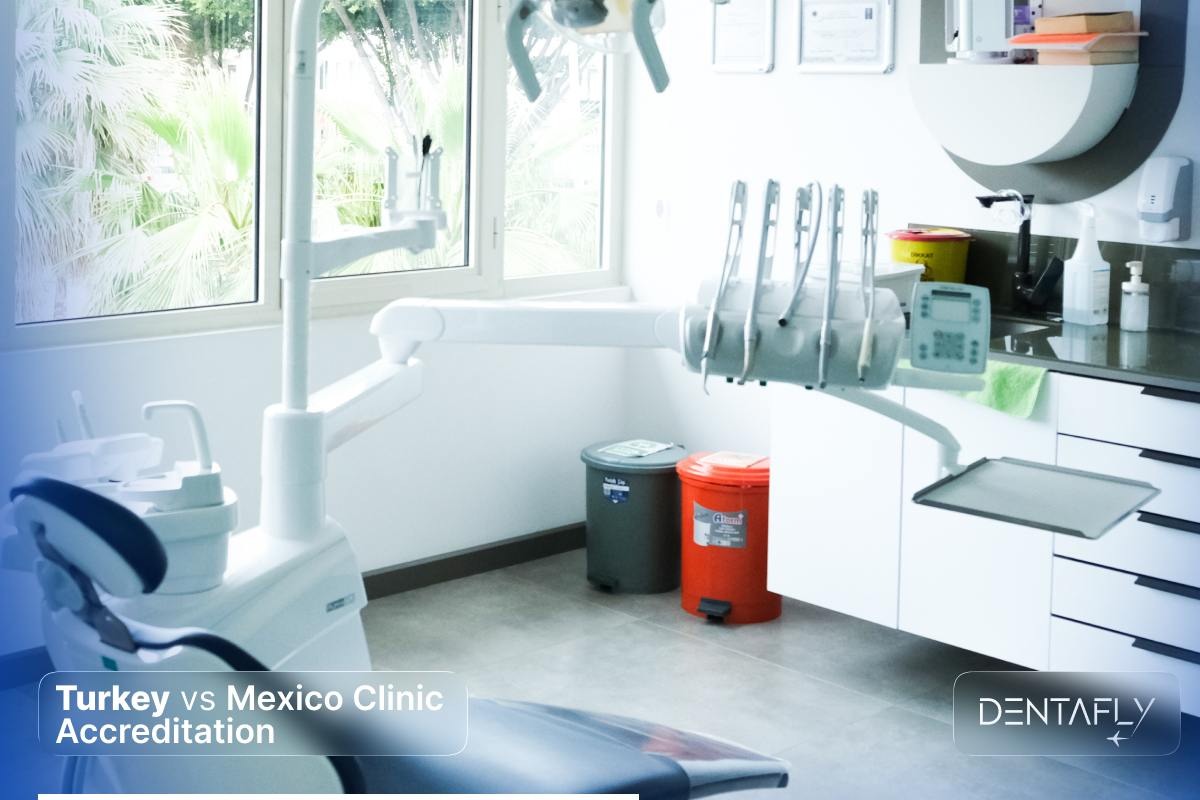
Quality standards represent the most significant difference between Turkey and Mexico for dental tourism. Both countries have excellent clinics and questionable ones, but the international accreditation density differs measurably between premium tiers.
Mexico’s regulatory framework
Mexican dental clinics operate under SSA (Secretaria de Salud) licensing through state health departments. Accreditation through CSG (Consejo de Salubridad General) is voluntary and rare among border-town tourism clinics. JCI (Joint Commission International) accreditation exists at major Mexican hospitals but rarely at standalone dental clinics. ISO 9001:2015 certification appears in higher-tier facilities but not consistently.
Turkey’s regulatory framework
Turkey operates a parallel system through the Ministry of Health’s Health Tourism Department, which licenses specific clinics for international patient treatment. Top-tier Turkish dental tourism clinics additionally hold AACI accreditation (Accreditation Association for Ambulatory Health Care International) plus ISO 9001:2015. The licensing requirements for international care are stricter than Mexico’s SSA framework.
| Accreditation | Typical Mexican Border Clinic | Top Turkey (Dentafly) |
|---|---|---|
| National License (SSA / Sağlık Bakanlığı) | Required | Required |
| ISO 9001:2015 | Sometimes | Standard at top tier |
| AACI International | Very rare | Yes (C477-2025-MSC-TR) |
| JCI Hospital | Hospital-only | Top hospitals only |
| National Health Tourism License | Optional | Required for international care |
| FDA/CE Material Compliance | Required (varies) | Required |
When American patients ask me how Turkish accreditation compares to Mexican accreditation, my honest answer is that the gap exists but it’s about consistency rather than ceiling. Mexico’s best clinics meet excellent international standards. The challenge is identifying them — accreditation density at the tourism-clinic level is significantly lower than Turkey’s. AACI specifically holds dental tourism clinics to surgical safety, infection control, and patient communication standards that go well beyond basic licensing.
Lead Maxillofacial Surgeon, Dentafly
Dentist Training: US vs Turkish vs Mexican
Training pathway differences matter for outcome predictability. American patients deserve to understand what each country’s dental education actually produces.
United States training
- Path: 4-year undergraduate degree + 4-year DDS/DMD program (8 years total)
- Specialization: 3-6 additional years for endodontics, oral surgery, periodontics
- Licensing: State-by-state with NBDE/INBDE board examinations
- Continuing education: 25-50 hours annually depending on state
Turkish training
- Path: 5-year integrated dental program from high school
- Specialization: 4-year specialty residencies (maxillofacial surgery, periodontics, prosthodontics)
- Licensing: Ministry of Health centralized licensing
- Mandatory service: 1-year compulsory service in public clinics post-graduation
- International fellowships: Common in USA, Germany, Switzerland
Mexican training
- Path: 5-year integrated dental program from high school
- Specialization: 2-4 year postgraduate programs varying by state
- Licensing: Cédula Profesional via federal system
- Border-clinic dentists: Often hold US dental school degrees in addition
Specialist availability for complex cases
The practical difference shows in specialist availability:
- Maxillofacial surgeons: Turkey has approximately 1,800 registered specialists, Mexico has approximately 950. For complex cases like zygomatic implants or surgical revision, Turkey offers more specialist access.
- Implantologists: Both countries have certified implant practitioners. Turkey’s higher international tourism volume creates more case experience hours per specialist.
- Prosthodontists: Turkey has more in-house lab integration. Mexican clinics often outsource prosthesis fabrication.
Travel from US Cities to Antalya vs Cancun
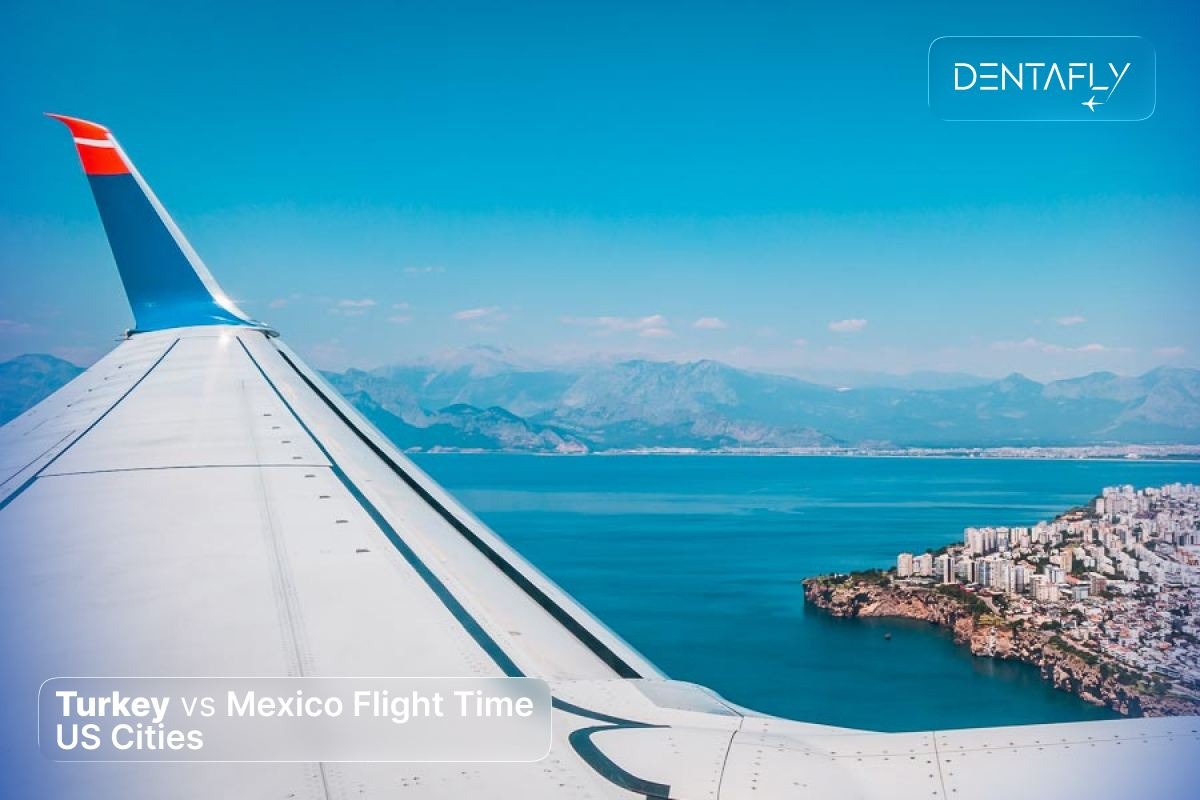
Geographic distance is Mexico’s principal advantage for American patients. The difference matters more for short procedures (single implant) than for full-mouth treatments where the cost savings dwarf flight costs.
| US City | Flight Time to Cancun | Flight Time to Antalya | Time Difference |
|---|---|---|---|
| New York (JFK) | 3h 45min | 10h 30min (1 stop) | +6h 45min |
| Los Angeles (LAX) | 5h 15min | 14h 15min (1 stop) | +9h |
| Chicago (ORD) | 3h 30min | 11h (1 stop via IST) | +7h 30min |
| Houston (IAH) | 2h 45min | 12h 15min (1 stop) | +9h 30min |
| Miami (MIA) | 2h 30min | 11h 30min (1 stop) | +9h |
| San Francisco (SFO) | 5h 45min | 14h 30min (1 stop) | +8h 45min |
| Dallas (DFW) | 2h 45min | 12h 30min (1 stop) | +9h 45min |
| Atlanta (ATL) | 2h 45min | 11h (1 stop) | +8h 15min |
Cost-time math for American patients
Round-trip flights add roughly $150-$400 for Mexico vs $800-$1,400 for Turkey from major US cities. For a single implant ($1,200 Mexico vs $700 Turkey), the flight cost difference exceeds the treatment savings. For full-mouth treatment ($14,000 Mexico vs $8,000 Turkey), the $6,000 savings dwarfs the additional flight cost by 8-10x.
Practical breakeven: Treatments above $4,000 typically favor Turkey on total cost including flights. Below that threshold, Mexico’s geographic proximity wins financially.
Antalya Airport infrastructure
Antalya International Airport handles approximately 36 million passengers annually with a dedicated medical tourism reception area. Multilingual coordinators meet international patients at arrival, handle Customs assistance, and coordinate transfers to partner hotels and clinics. American patients typically transit through Istanbul (IST), Frankfurt (FRA), Paris (CDG), or Amsterdam (AMS) before connecting to Antalya.
Warranty Coverage and US Aftercare
Long-term warranty coverage is where the Turkey vs Mexico decision often crystallizes for American patients. The geographic proximity advantage of Mexico becomes less meaningful if your warranty requires return travel for routine claims.
Mexican clinic warranty typical model
Mexican dental tourism clinic warranties vary widely:
- Basic implant warranty: 1-5 years on fixture, prosthesis often shorter
- Premium clinic warranty: 5-10 years on implant, 5-7 years on prosthesis
- Warranty processing typically requires return travel to Mexico
- Some clinics offer “international warranty cards” with limited US dentist acceptance
Dentafly’s Global Warranty Network
Dentafly Turkey provides comprehensive coverage processed in the US:
- Lifetime warranty on implant fixtures (manufacturer guaranteed)
- 10-year warranty on prosthetic work (crowns, bridges, abutments)
- US dentist network for warranty assessment without return travel
- Telephone/video consultation support for your local US dentist
- Documentation package with implant batch numbers, surgical protocols, prosthesis specifications
How the Global Warranty Network operates
If a US patient experiences a warranty issue, the process works as follows. Local US dentist documents the concern with photographs and X-rays. Dentafly validates the warranty claim within 5 business days. Replacement components ship to the US dentist for placement. Placement fees covered by warranty up to defined limits ($1,500 per single implant placement). For complex revisions, we coordinate a brief return trip to Antalya with priority booking.
In our Antalya clinic, we treat US patient warranty differently than UK patient aftercare. UK patients have our owned London clinic for in-person follow-up. American patients have the Global Warranty Network supplemented by international fellowships our team holds. Most US patients use their local dentist for routine maintenance with our protocol guidance. The principal limitation is the lack of physical UK-style aftercare in the US, but the warranty coverage itself is comprehensive.
Implantology & Periodontology Ph.D., Dentafly
Medicare and US Insurance Reality
American patients researching Turkey vs Mexico face the same insurance reality regardless of destination. Original Medicare excludes dental implants entirely under standard rules, with only narrow exceptions for cancer reconstruction or major trauma.
Medicare Advantage limits
While 98% of Medicare Advantage plans now include some dental coverage, 2026 trends show what industry analysts call a “benefit pullback.” Most plans cap annual dental at $1,300 to $2,000. Given that a full-mouth restoration costs $50,000-$75,000 in the US, even premium Advantage plans cover only a small fraction of typical treatment costs.
State Medicaid coverage
Most state Medicaid programs do not cover adult dental implants, classifying them as elective. California, Ohio, and West Virginia may cover specific medically necessary cases (severe trauma, oral cancer reconstruction) with annual benefit caps that rarely match actual costs.
HSA and FSA reimbursement
Dental implants typically qualify as IRS Section 213(d) medical expenses for HSA/FSA reimbursement when documented as medically necessary. Both Mexican and Turkish clinics provide detailed receipts for US tax purposes. The reimbursement applies to:
- Treatment fees (implants, crowns, bridges)
- Travel costs (flights, ground transportation)
- Lodging up to $50/night per IRS Publication 502
- Required medical consultations and X-rays
Consult a US tax professional for your specific situation. Documentation must include medical necessity, treatment receipts, and transportation records.
The Mexican Border Clinic Warning
This section needs to acknowledge a difficult truth about Mexican dental tourism that most comparison articles avoid. Border-town clinics in Tijuana, Los Algodones (Yuma County), and Nuevo Progreso vary enormously in quality. Some are excellent. Others have genuinely concerning practices that have led to documented patient harm.
Specific concerns with the lowest-tier border clinics
- Implant brand substitution: Patients quoted Straumann or Nobel implants sometimes receive unbranded Korean or Chinese alternatives without disclosure
- Sterilization documentation gaps: Class B autoclave usage and batch testing not consistently documented
- Specialist credentials unclear: Some clinics list “implantologists” who hold weekend course certifications rather than maxillofacial residency training
- Aftercare absence: Many border clinics provide minimal follow-up infrastructure
- Warranty processing difficulties: Some clinics close or rebrand, leaving warranties effectively void
How to identify safer Mexican clinics
To be clear, excellent Mexican dental clinics exist. They typically display:
- JCI accreditation or ISO 9001:2015 certification documentation
- Maxillofacial surgeons with university hospital training, not weekend-course certifications
- Specific implant brand and batch number disclosure
- Detailed written warranty terms with named processing locations
- Trustpilot or independent review platform presence with 200+ reviews
- Decade-plus operating history at the same address
If Anything Goes Wrong, Global Support Has You Covered
One of the biggest concerns when comparing Turkey and Mexico is what happens if a complication arises after you return to the US. Mexican clinics typically require return travel for warranty work, which removes their geographic proximity advantage when issues arise.
Dentafly handles this differently for American patients. Our Global Warranty Network coordinates with US-certified dentists for routine maintenance, hygiene support, and warranty assessments under our protocol guidance. UK patients have direct access to our owned London clinic at NW9 8SN, while American patients receive equivalent warranty coverage through documented protocol partnerships.
- 📍 230 Church Lane, London NW9 8SN (UK aftercare clinic)
- 📞 +44 7462 172110 (international support)
- ✉️ [email protected]
- 🕐 Mon-Fri 9:00-18:00 GMT · Sat 10:00-15:00
- 🇺🇸 Global Warranty Network for US patients
- 🛡️ Lifetime implant + 10-year prosthesis warranty
Real American Patient Experiences
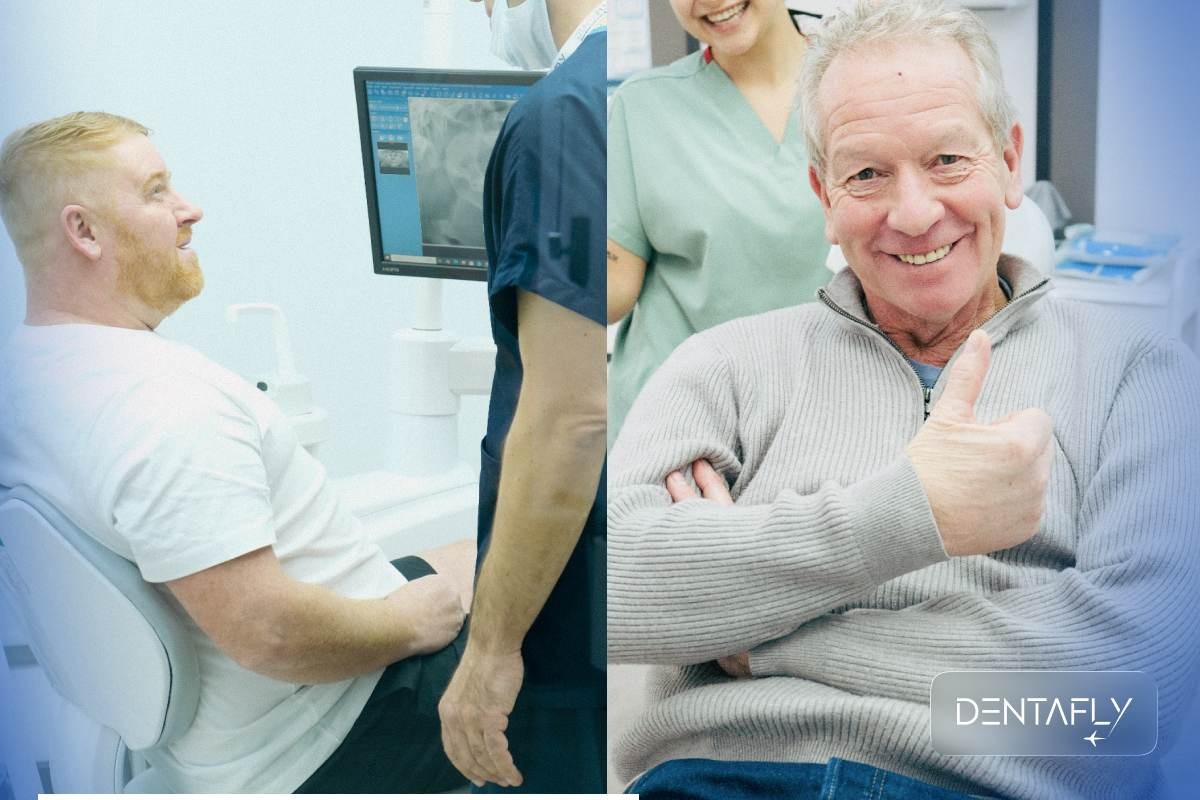
“Houston-based, quoted $52,000 for All-on-4 in Florida and $48,000 in Texas. My Medicare Advantage plan covered $1,800. Researched Mexico first, but the Tijuana clinic I shortlisted couldn’t disclose specific implant brand batch numbers. Found Dentafly through a Reddit thread, did my homework, flew Houston-to-Frankfurt-to-Antalya. Total spend including flights, hotels, and everything else: $13,200 for the lower arch. Coming back next year for the upper arch. Same protocol, same brand implants, completely fitted result. Best dental decision of my life.”
“Lived in San Diego, drove to Tijuana for years for routine dental work. When I needed full-mouth implants, the Tijuana quote was $14,500 with 3-year warranty. Researched alternatives and found Dentafly. Total quote $7,800 with lifetime implant warranty. The flight from LAX added $1,200 round trip. Net savings: $5,500 plus dramatically better warranty terms. Three years post-treatment, no issues, regular cleaning at my San Diego dentist using Dentafly’s protocol documents.”
“Miami-based, originally booked Cancun for All-on-6 because of the resort recovery experience. The clinic looked great in marketing materials but couldn’t provide AACI documentation when I asked specifically. Cancelled and rebooked Antalya. The flight was longer (10 hours vs 2.5), but the all-inclusive package included recovery hotel. Total cost less than Cancun quote despite the longer flight. Surgical experience was professional throughout, English-speaking team, no language barriers.”
“Phoenix-based, considered Los Algodones (Yuma County) extensively because of proximity. Every quote came back without specific brand documentation, just ‘European quality implants’ phrasing. Switched research to Turkey when I learned about AACI accreditation requirements. Dentafly provided full Straumann documentation with batch numbers before booking. Treatment in Antalya was straightforward, the recovery hotel was actually nicer than my original Mexican planning. Two years post-treatment, perfectly healthy implants.”
“Chicago-based, needed zygomatic implants due to severe upper jaw bone loss after my previous implants failed. Three Mexican clinics referred me to specialty centers in Mexico City because they couldn’t handle the case. Dentafly’s Lead Maxillofacial Surgeon handled my entire case in Antalya. The complexity of zygomatic surgery requires hospital-trained specialists, which weren’t readily available at the Mexican border clinics I researched initially. The surgical outcome has been excellent, six months post-treatment.”
Real Reviews from Verified Patients
Live Trustpilot reviews from our 1,027+ verified patients across the US, UK, Ireland, Australia, and Germany.
When Mexico Is the Better Choice
Mexico genuinely outperforms Turkey for some specific patient profiles. We acknowledge these advantages because honest Turkey vs Mexico comparison helps both countries’ patients make better decisions.
Mexico makes more sense if you:
- Live in southwestern US states within driving distance to Tijuana, Los Algodones, or Nuevo Progreso. Same-day return possibility for routine work.
- Need single-tooth implants where the cost savings are smaller than transcontinental flight differential.
- Speak Spanish fluently and prefer Spanish-language clinical communication.
- Have specific Mexican family or cultural connections that make recovery time more comfortable.
- Choose a JCI-accredited Mexican facility with documented warranty terms and US dentist network access.
- Need treatment timing during summer months when Yucatán Peninsula offers excellent recovery weather (similar to Antalya).
Turkey makes more sense if you:
- Need full-mouth treatment where cost savings dramatically exceed flight cost differences.
- Want maximum AACI/ISO accreditation density with predictable quality standards.
- Need complex cases like zygomatic implants, full-mouth revision, or extensive bone grafting.
- Prioritize lifetime warranty coverage with US-network claim processing.
- Want premium brand documentation with full batch number disclosure before booking.
- Prefer Mediterranean climate with combined dental-vacation experience.
- Need maxillofacial surgical expertise not consistently available at Mexican border clinics.
Ready to Compare Specific Treatment Costs?
Send us your dental records or X-rays. We provide transparent USD quotes you can directly compare against any Mexican clinic offer.
Frequently Asked Questions
Is Turkey or Mexico cheaper for dental implants?
Is it safer to get dental implants in Turkey or Mexico?
Which country is closer for American patients?
Does Medicare cover dental implants abroad?
Are American dentists better trained than Turkish dentists?
Can I claim travel costs for tax purposes?
What about complications when I return to the US?
Do Mexican dental tourism clinics accept US insurance?
How long does treatment take in each country?
Which country has better warranty coverage?
Are language barriers a problem in Mexico vs Turkey?
What about Cancun vs Tijuana vs Antalya recovery experience?
Related Reading
- Complete Dental Implants in Turkey Guide: Pillar overview of all implant options
- Dental Implant Costs in Turkey: Full pricing breakdown
- Turkey vs Hungary Dental Implants: European comparison
- UK Aftercare London Clinic: Owned NW9 8SN clinic detail
- All-on-4 Dental Implants: Cost-effective full-arch solution
- Zygomatic Implants: Complex cases requiring maxillofacial expertise
- Single Tooth Implants: Single restoration option
- Full Mouth Implants Packages: Comprehensive treatment
- Is It Safe to Have Implants in Turkey?: Safety analysis
- Meet Our Dental Team: Specialist credentials
- Patient Reviews: 1,027+ Trustpilot testimonials
- Free Comparison Quote: Personalised treatment plan
Ready to Compare Your Options?
We provide honest, transparent USD quotes for all dental implant treatments. Compare our Turkey pricing against any Mexican clinic offer, with no obligation.