Choosing between Turkey vs Hungary dental implants is genuinely difficult — both countries treat hundreds of thousands of UK patients annually with comparable brands and surgical protocols. Hungary built its dental tourism reputation in the 1990s, when British patients first started crossing to Budapest for cheaper crowns and implants. Turkey arrived later, in the mid-2010s, with even lower prices and a more aggressive growth model. Each country has real strengths, real weaknesses, and a few uncomfortable truths the marketing materials skip over.
This Turkey vs Hungary comparison is written from a Turkish clinic perspective, which means it has a built-in bias. We have tried to compensate by citing independent data, acknowledging Hungary’s genuine advantages, and pointing out where UK patients might prefer Hungary over Turkey. The goal is to help you make a real decision, not to win you over for our clinic specifically. For a broader view of all implant options, see our complete dental implants in Turkey guide. For the full multi-country picture beyond Hungary, see our complete best country for dental implants guide.
Cost Comparison: Turkey vs Hungary 2026
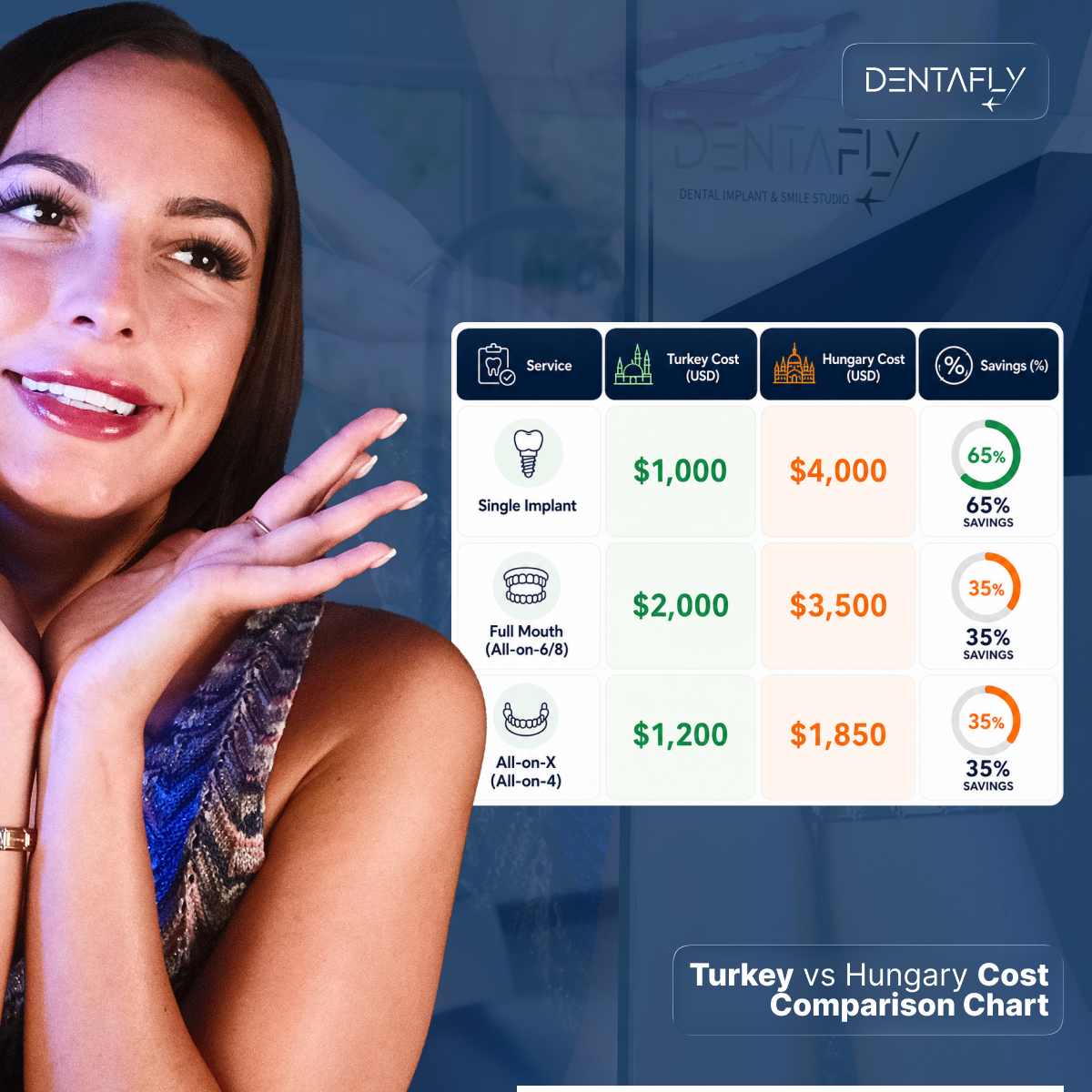
Cost is where Turkey holds its biggest advantage in the Turkey vs Hungary comparison. The reasons behind this are structural: lower healthcare overhead, lower clinic operating costs, and more competitive market dynamics with thousands of accredited dental clinics serving international patients. Hungary’s prices have risen steadily as Budapest gentrified and labor costs increased through EU integration.
| Treatment | UK Private (Avg) | Hungary (USD) | Dentafly Turkey (USD) | Savings |
|---|---|---|---|---|
| Single Implant + Crown | $3,200-$4,200 | $4,000 | $1,000 | 65% |
| Premium (Straumann/Nobel) | $4,500-$6,000 | $5,200 | $1,800 | ~65% |
| All-on-4 Per Arch | $17,000-$21,000 | $1,850 per implant | $1,200 per implant | 35% |
| All-on-6 Per Arch | $20,000-$26,000 | $2,300 per implant | $1,500 per implant | 35% |
| Full Mouth (All-on-6/8) | $36,000-$52,000 | $3,500 per arch base | $2,000 per arch base | 35% |
| Bone Graft (Sinus Lift) | $1,950-$3,250 | $1,400 | $700 | 50% |
| Zygomatic Implant | $10,400-$15,600 | Limited availability | $3,250-$5,200 | N/A |
The savings on single implants are most striking at 65% — a UK patient paying $4,000 in Hungary saves $3,000 by choosing Turkey. The cost gap reflects local economics, not clinical compromise. Both countries use the same global brands (Straumann, Nobel Biocare), same materials (Geistlich Bio-Oss), and largely the same treatment protocols.
The 2024 Medical Tourism Index by the Medical Tourism Association ranked Turkey 2nd globally for affordability across dental specialties (after Mexico). Hungary ranked 7th, partly due to rising labor costs in EU-integrated economies. UK patient surveys conducted by Dental Tourism UK in 2024 confirmed average savings of $5,800 when choosing Turkey over Hungary for comparable treatment.
Compare Your Treatment Cost
Send us your X-ray or CBCT scan for a free comparison quote. We’ll show you exactly what your specific treatment costs in Turkey vs Hungary, with no obligation.
Quality Standards and Accreditation
Both Turkey and Hungary maintain internationally recognized dental quality standards, but the accreditation systems differ in important ways. Understanding these differences helps UK patients evaluate clinic credibility before booking either Turkey or Hungary.
Hungary’s regulatory framework
Hungarian dental clinics operate under EU medical device regulations (MDR 2017/745) and follow national licensing through the State Office of Public Health. Most reputable clinics hold ISO 9001:2015 quality management certification. Hungary lacks a single dominant medical tourism accreditation body, with clinics typically displaying multiple national and international certifications.
Turkey’s regulatory framework
Turkey operates a parallel system through the Ministry of Health’s Health Tourism Department, which licenses specific clinics for international patient treatment. Top-tier clinics additionally hold AACI accreditation (Accreditation Association for Ambulatory Health Care International) and ISO 9001:2015. JCI (Joint Commission International) accreditation is also available, particularly for hospital-based dental units.
| Accreditation | Typical Hungary | Top Turkey (Dentafly) |
|---|---|---|
| EU MDR Compliance | Required | Voluntary (followed) |
| ISO 9001:2015 | Common | Standard at top tier |
| AACI International | Rare | Yes (C477-2025-MSC-TR) |
| JCI Hospital | Hospital-only | Top hospitals only |
| National Health Tourism License | Optional | Required for international care |
| FDA/CE Material Compliance | Required | Required |
When patients ask me whether Turkish or Hungarian dental qualifications are more rigorous, my honest answer is that the underlying training is comparable. Both countries follow EU-aligned 5-year dental school programs with mandatory residency. The practical difference shows in specialization: Turkey produces more maxillofacial surgeons annually because complex implant cases create market demand. Hungary’s specialist training is excellent but more concentrated in fewer institutions.
Implantology & Periodontology Ph.D., Dentafly
Dentist Qualifications and Specializations
Dental qualifications in both Turkey and Hungary meet EU standards, but specialty availability differs based on each country’s market structure.
Education paths compared
- Hungary: 5-year DMD program at 4 universities (Semmelweis, Debrecen, Szeged, Pécs). Many programs taught in English to attract international students.
- Turkey: 5-year dental degree at 78 dental faculties. Mandatory 1-year compulsory service in public clinics, often in rural areas. Specialist programs require 4 additional years.
Specialist availability for implant cases
The principal practical difference shows in specialist availability for complex implant work:
- Maxillofacial surgeons: Turkey has approximately 1,800 registered specialists vs Hungary’s 350. For complex cases like zygomatic implants or revision surgery, Turkish patients have shorter wait times and more clinic options.
- Periodontists: Both countries train similar numbers proportionally. Hungarian periodontology has strong academic tradition through Semmelweis University.
- Prosthodontists: Turkey has more in-house lab integration due to dental tourism volume. Hungarian clinics often outsource laboratory work.
- Implantologists: Both countries have certified implant practitioners. Turkey’s volume creates more practical experience hours per specialist.
Continuing education and international fellowships
Both countries’ dentists participate in international fellowships. Turkish specialists frequently train in USA, Germany, and Switzerland. Hungarian specialists similarly attend international programs, with particular strength in German and Austrian fellowships due to geographic proximity.
Clinic Facilities Comparison
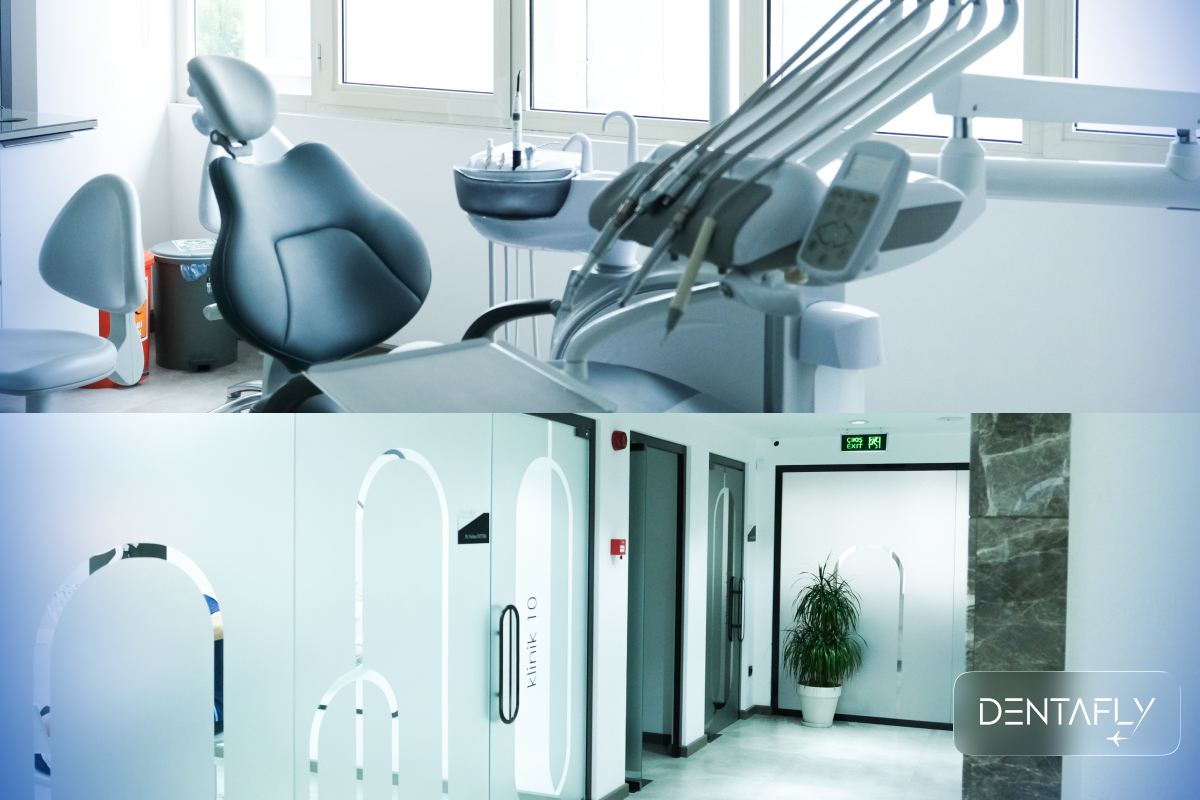
Beyond credentials, the physical clinic environment matters for both clinical outcomes and patient comfort. Modern dental tourism clinics in both countries have invested heavily in facility upgrades over the past decade, but the integration of technology and patient experience differs.
Equipment and technology
Top Turkish dental tourism clinics typically operate full digital workflow infrastructure: CBCT 3D imaging, intraoral scanners (iTero), 5-axis CNC milling for same-week prosthesis fabrication, and laser dentistry equipment. Many integrate robotic implant placement systems (X-Guide). Equipment turnover cycles tend to be 5-7 years to maintain competitive positioning.
Hungarian dental tourism clinics have similar core equipment but slightly older average turnover cycles (7-10 years). Digital integration is widespread but in-house lab capability is less common — many Hungarian clinics outsource prosthesis fabrication to specialized labs, adding 3-5 days to treatment timelines.
Sterility and safety standards
Both countries maintain EU-compliant sterilization protocols. Top Turkish clinics typically operate Class B autoclaves with documented batch testing. Hungarian clinics meet identical standards through different national accreditation pathways.
Patient comfort amenities
Turkish dental tourism clinics often integrate hospitality elements that Hungarian clinics traditionally separate. Examples include in-clinic refreshments, multilingual coordinators present at each appointment, comprehensive transfer arrangements, and treatment-room amenities like noise-cancelling headphones. Hungarian clinics typically focus on clinical efficiency with hospitality services arranged through external partners.
Travel and Logistics from the UK
Travel convenience favors Hungary on raw flight time but Turkey on patient transfer infrastructure. The breakdown matters more than the headline numbers suggest.
| Logistics Factor | Hungary (Budapest) | Turkey (Antalya) |
|---|---|---|
| Flight time from London | 2h 40min | 4h 0min |
| Direct UK airport options | 5 airports | 12 airports |
| Average return flight cost (2026) | £140-£280 | £180-£380 |
| Airport to clinic transfer | 20-45 min taxi | 15 min VIP transfer |
| Medical concierge availability | Limited at airport | Standard with package |
| Patient hotels near clinic | City-dispersed | Walking distance options |
| Visa requirements | None (EU) | e-Visa £25 (15-min online) |
| Currency | HUF (Hungarian Forint) | TRY / EUR / GBP accepted |
Direct flight options from regional UK airports
To Budapest: London Heathrow, London Gatwick, London Luton, Manchester, Edinburgh (limited frequency)
To Antalya: London Heathrow, London Gatwick, London Stansted, London Luton, Manchester, Birmingham, Bristol, Newcastle, Glasgow, Edinburgh, Belfast, Cardiff (especially May-October)
The UK regional airport advantage favors Turkey for patients outside London. A patient in Newcastle has a direct Antalya flight but typically needs to transit through London for Budapest.
Antalya’s medical tourism infrastructure
Antalya International Airport handles approximately 36 million passengers annually with a dedicated medical tourism reception area. Multilingual coordinators meet patients at arrival, handle Customs assistance for those traveling with medical documentation, and coordinate transfers to partner hotels and clinics.
Budapest Airport (Liszt Ferenc International) is a regular international airport with strong tourism infrastructure but less specialized medical tourism services. Patients typically arrange their own transfers via taxi or pre-booked private cars.
UK Aftercare: The Critical Difference
This is where Turkey vs Hungary differences matter most for long-term patient outcomes. Aftercare quality varies enormously within both countries based on individual clinic policies and infrastructure.
The honest reality of dental tourism aftercare
Most dental clinics in both Turkey and Hungary handle aftercare through three main models. The first is no aftercare provision, leaving patients to find UK dentists for any follow-up. The second is broker partnerships with independent UK practices. The third, far less common, is owned UK clinical operations.
Hungarian clinic aftercare typical model
Most Hungarian dental tourism clinics rely on partner-network broker arrangements. The patient receives a list of UK dental practices that have signed referral agreements. These partners are independent businesses, not staffed by the Hungarian clinic. Patients often pay UK private rates for any consultations, with the original Hungarian clinic reimbursing some costs after submission.
Dentafly’s owned UK clinic model
Dentafly operates a single owned clinic at 230 Church Lane, London NW9 8SN with dedicated permanent staff. The dentist who reviews UK patients in London has direct access to original Antalya treatment records, X-rays, and surgical notes. Routine reviews, X-ray monitoring, hygiene support, warranty claims, and emergency consultations all happen on UK soil at no additional cost.
This is a significant practical difference. For a UK patient living in Manchester, the choice is between a 4-hour train to London (Dentafly model) or paying a local broker partner UK private rates with reimbursement processing (typical Hungarian model). For more details, see our UK aftercare London clinic guide.
In our Antalya clinic, we treat the UK aftercare question as the central decision-point for patients comparing destinations. Hungarian clinics often have excellent surgical outcomes, but the post-treatment relationship is genuinely different. When a patient sits in our London clinic for their 6-month integration check, the dentist opens the file from their Antalya surgery in real time. That continuity of records and personnel is what makes the difference between dental tourism and proper long-term care.
Lead Maxillofacial Surgeon, Dentafly
Patient Experience and Satisfaction
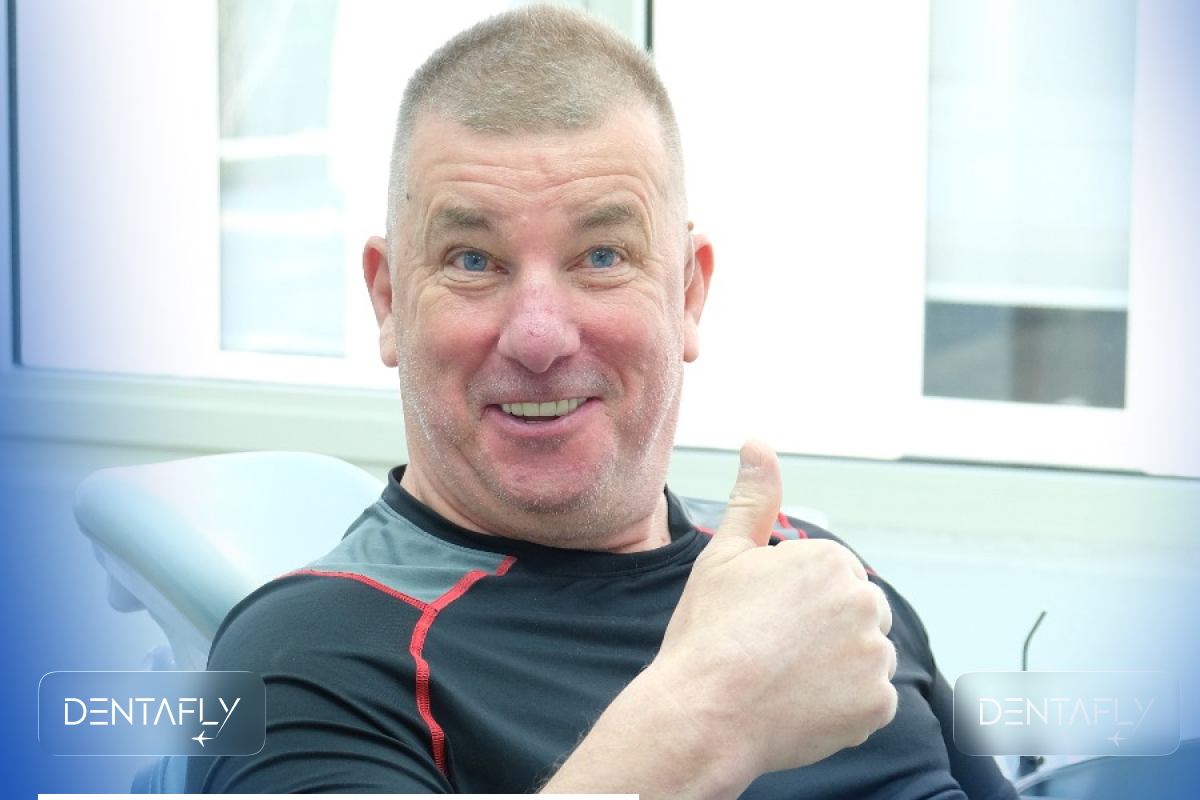
Patient satisfaction surveys conducted independently by Trustpilot and Medical Tourism Association show measurable differences between Turkey and Hungary dental tourism experiences for UK patients.
Trustpilot ratings comparison (2024 data)
- Top 10 Turkish dental tourism clinics: Average 4.7/5 stars across 18,400+ reviews
- Top 10 Hungarian dental tourism clinics: Average 4.4/5 stars across 7,200+ reviews
- Dentafly specifically: 4.9/5 across 1,027+ reviews
Net Promoter Score differences
The Medical Tourism Index 2024 measured Net Promoter Score (NPS) — how likely patients are to recommend their treatment country to a friend. Turkey scored +58, Hungary scored +44. The difference primarily reflects all-inclusive package experience, where Turkey’s integrated hospitality contributes to overall satisfaction beyond pure clinical outcomes.
Common complaint patterns
Independent review analysis shows the principal complaints differ between countries. Hungary’s most common patient complaints relate to language barriers in non-clinical staff and unclear pricing for additional procedures. Turkey’s most common complaints relate to flight delays during return travel and minor variations in hotel quality between provider tiers. Neither pattern relates to clinical outcomes specifically.
If Anything Goes Wrong, London Has You Covered
One of the biggest concerns when comparing Turkey and Hungary is what happens if a complication arises after you return to the UK. Hungarian clinics typically refer patients to broker-network UK practices that may charge consultation fees or take weeks to process warranty claims.
Dentafly handles this differently. If your dental implants need post-operative attention, screw retightening, occlusion adjustment, or warranty assessment, our owned London clinic provides immediate face-to-face support. Same-day or next-day appointments for emergencies. No travel back to Antalya for routine concerns.
- 📍 230 Church Lane, London NW9 8SN
- 📞 +44 7462 172110
- ✉️ [email protected]
- 🕐 Mon-Fri 9:00-18:00 · Sat 10:00-15:00
- 🚇 12 min walk from Colindale (Northern Line)
- 🚗 8 min from M1 J2, free patient parking
Real UK Patient Experiences
One of our recent UK patients, Claire, shared her detailed experience comparing Turkey vs Hungary before choosing Dentafly for her All-on-4 Toronto Hybrid treatment. Her story illustrates the real decision-making process UK patients face:
“Spent six months researching Hungary versus Turkey before booking. Hungary won on flight time, Turkey won on cost. The decisive factor was the London aftercare clinic at NW9 8SN. My husband and I worked out we would save £6,200 going to Antalya rather than Budapest, and we would not have to fly back for routine follow-ups. The Antalya experience itself was excellent, professional from start to finish.”
“My initial preference was Hungary because of proximity. But when I researched specific clinics, the Hungarian options I shortlisted did not have maxillofacial surgeons in-house. I needed zygomatic implants due to severe upper jaw bone loss. Two Hungarian clinics referred me to specialty centers in Austria, which doubled the logistical complexity. Dentafly handled my case in one location with their lead maxillofacial surgeon. That practical reality made the decision.”
“Booked Hungary in 2022, treatment was good, but two years later I needed a screw retightening on one of the abutments. Local UK ‘partner clinic’ charged me £180 for the appointment and the Hungarian clinic took six weeks to reimburse. When I needed implants for my wife in 2024, we chose Dentafly Turkey specifically because of the owned London clinic. The contrast in aftercare experience has been significant.”
“Lived in London so proximity was less of an issue, but the cost difference still matters. Quoted £18,500 for All-on-6 in Budapest using Straumann implants. Same brand, same protocol, £6,800 at Dentafly. Used the difference to fly business class both ways and stay in a 5-star Antalya hotel. Total experience cost less than half the Budapest quote.”
“Edinburgh-based, no direct flights to Budapest, would have needed Heathrow connection both ways. Direct Edinburgh to Antalya flight was a major logistical advantage I had not factored in initially. Treatment quality was excellent, and the London clinic visits for follow-up are easier from Edinburgh than they sound, just one flight away with overnight options.”
When Hungary Is the Better Choice
Hungary genuinely outperforms Turkey for some specific patient profiles. We acknowledge these advantages because honest Turkey vs Hungary comparison helps both countries’ clinics serve patients better.
Hungary makes more sense if you:
- Live in London or south-east England with frequent travel preferences. The 1.5-hour flight time difference becomes meaningful for repeat trips.
- Are comfortable with broker-network aftercare and prefer a UK partner practice closer to home over central London.
- Need treatment timing during summer months. Budapest has perfect summer recovery weather (22-26°C), comparable to Antalya without the intensity.
- Prefer Central European cultural experience over Mediterranean. Some patients specifically seek Budapest’s architecture and thermal baths.
- Have specific Hungarian language or family connections that ease the experience.
- Need straightforward implant work without complex surgical requirements. For routine cases, both countries deliver comparable outcomes.
Turkey makes more sense if you:
- Want maximum cost savings with the same brands and quality standards (up to 65% on single implants).
- Live outside London and benefit from direct regional UK flights to Antalya.
- Need complex cases like zygomatic implants, full-mouth revision, or extensive bone grafting.
- Prioritize UK aftercare through an owned clinic with dedicated staff.
- Travel with companions for combined holiday. Antalya’s beach-and-clinic combination offers Mediterranean recovery.
- Want winter treatment when Hungary’s climate adds discomfort to recovery.
Get Your Free Comparison Quote
Send us your treatment plan or X-ray. We’ll provide a transparent Antalya quote you can compare against any Hungarian clinic offer, with no obligation.
Frequently Asked Questions
Is Turkey or Hungary cheaper for dental implants?
Which country has better dental clinic accreditation?
Are Turkish dentists qualified compared to Hungarian dentists?
Which country offers better UK aftercare?
Is travel easier to Turkey or Hungary from the UK?
Which country has better recovery facilities?
Can I get All-on-4 implants in both countries?
Which country is safer for dental tourism?
Do both countries offer English-speaking staff?
What about long-term warranty in each country?
Are the dental brands the same in both countries?
Which country is best for complex cases like zygomatic implants?
Related Reading
- Complete Dental Implants in Turkey Guide: Pillar overview of all implant options
- Dental Implant Costs in Turkey: Full pricing breakdown
- UK Aftercare London Clinic: Our owned NW9 8SN clinic detail
- All-on-4 Dental Implants: Cost-effective full-arch solution
- Zygomatic Implants: Complex cases requiring maxillofacial expertise
- Single Tooth Implants: Single restoration option
- Full Mouth Implants Packages: Comprehensive treatment
- Dental Holiday Packages: All-inclusive options
- Is It Safe to Have Implants in Turkey?: Safety analysis
- Meet Our Dental Team: Specialist credentials
- Patient Reviews: 1,027+ Trustpilot testimonials
- Free Comparison Quote: Personalised treatment plan
Ready to Compare Your Options?
We provide honest, transparent quotes for all dental implant treatments. Compare our Turkey pricing against any Hungarian clinic offer, with no obligation.