GET QUOTE NOW
Sinus lifting is a procedure for patients who are looking to restore sufficient bone volume in the upper jaw for dental implants. There are several factors, like tooth loss or aging, that can cause insufficient bone density. And here comes sinus lifting, which opens space for bone grafting and eventually leads to effortless implant placement. Such a process enhances the possibility of long-term implant success as well as overall oral health.
Now why Turkey?
This is a country known for top-class dental procedures at reasonable prices. Nowadays, for dental tourists, Turkey has become a popular destination, and there are several reasons behind this. The reasons are described as follows:
- Skilled Professionals
- Modern Dental Technology
- Reputation of High-Quality Care
We at Dentalfly stand out as a ruptured provider in Turkey that offers top-tier sinus lift procedures at a reasonable price. Thus we ensure the patients receive both value and exceptional results.
Now What Exactly Is Sinus Lift Operation?
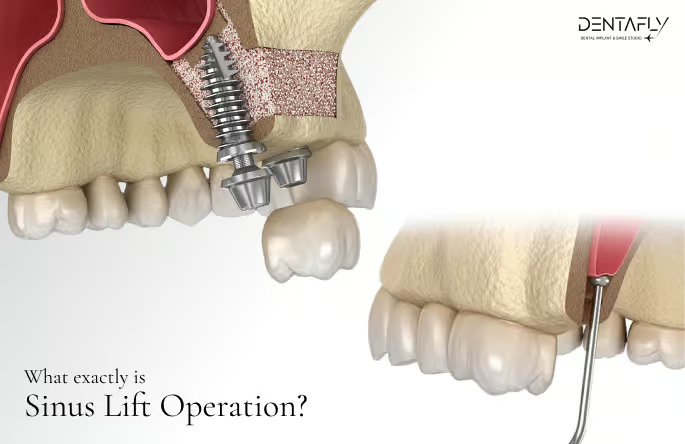
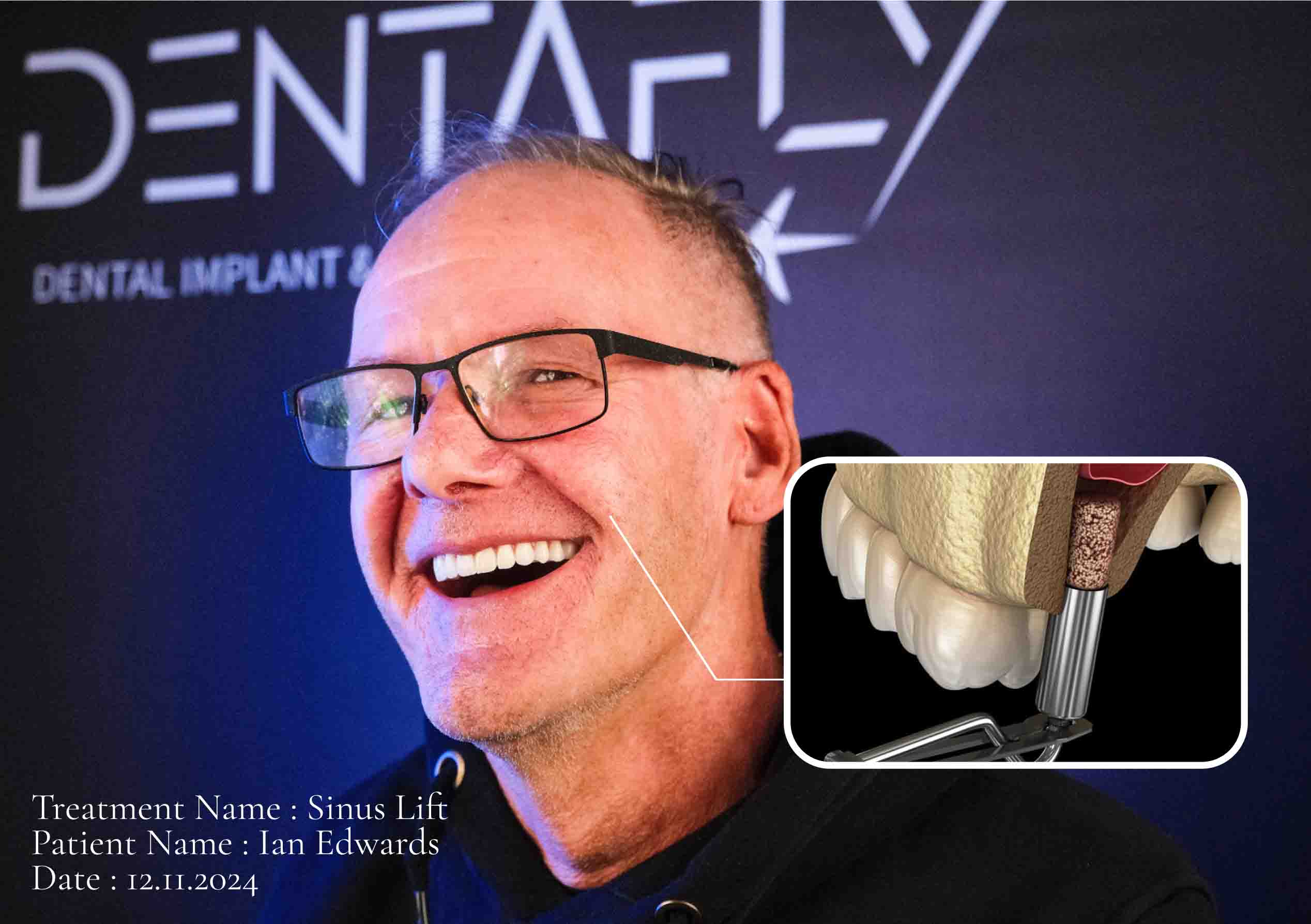
Now what is a sinus lift? A sinus lift, also known as sinus augmentation, is a procedure that increases bone value in the upper jaw by lifting the sinus floor and adding bone grafting material. This is essential when there is insufficient bone in the posterior maxilla (better known as the upper jaw) for the successful placement of dental implants.
Why Do You Need It? You may require a sinus lift if:
- There is inadequate bone density to support dental implants.
- The sinus is too close to the jaw, and an implant cannot be placed properly.
- There has been a loss of teeth and gum disease that leads to bone resorption in the upper jaw and weakening of the foundation for implants.
By restoring the bone structure required for securely fixing dental implants, sinus lifts establish the prerequisites for solid, long-lasting implants.
Determining Eligibility of a Sinus Lift
Who should indeed undergo this procedure? A sinus lift is necessary when the patient has a condition called inadequate bone density in the posterior maxilla, which is typically caused by lost teeth or the normal resorption of bones. In case your dentist finds your sinus too proximate to your jaw or there is not enough bone in the space available to place an implant, then you’ll be recommended to go for a sinus lift.
At DentaFLY, strict assessments lead to the eligibility decision for the sinus lift as follows:
- The X-rays and CT scans provide clear images of bone density and sinus positioning.
- Physical evaluation by the dentist to know about the health condition of your gums and teeth.
- Bring previous medical records and go through a full consultation before proceeding.
Visual Aids: DentaFLY may provide the patients with example X-rays and visual models for better conceptions of the anatomy of the zone as well as the benefits from the sinus lift for their implant treatment.
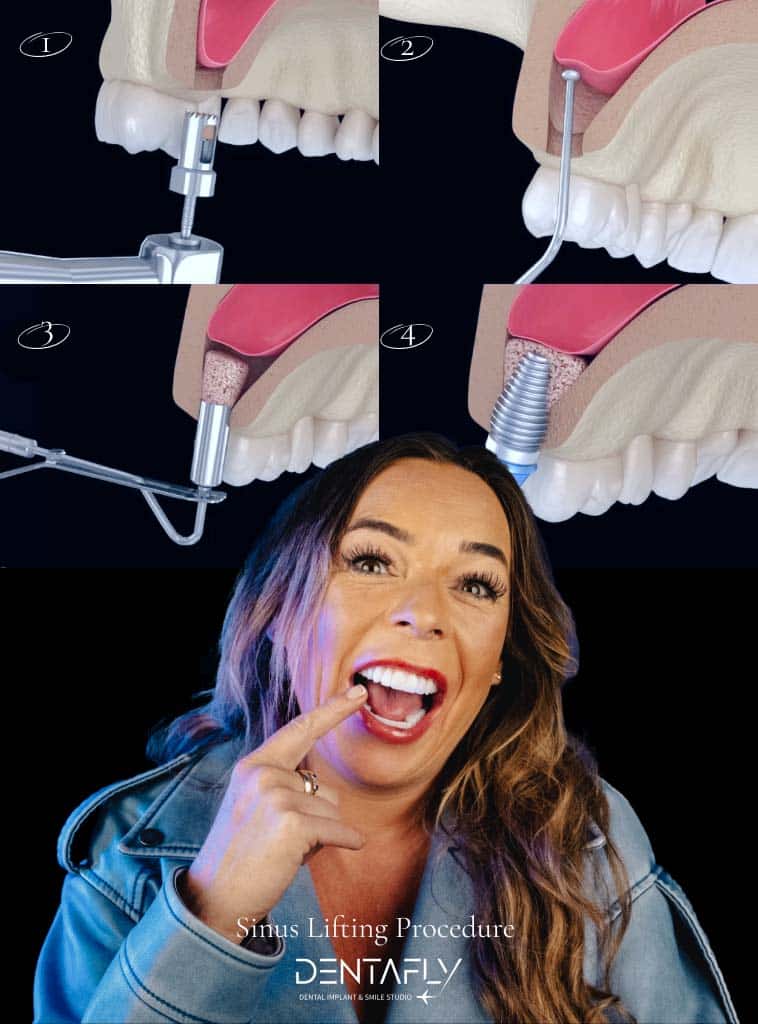
Explaining the Sinus Lifting Procedure:
- Consultation & Assessment: Detailed consultation to determine your suitability for the process
- Anaesthesia: Throughout the process, local anesthesia is implemented to give the patient maximum comfort.
- Incision: A small incision is created on the gum to reveal the sinus.
- Sinus Floor Elevation: Bone grafting material is placed to augment the volume of bone after the sinus membrane is slightly raised.
Source: https://www.researchgate.net/publication/376025543_Maxillary_Sinus_Lift_Procedures_An_Overview_of_Current_Techniques_Presurgical_Evaluation_and_Complications #:~:text=A%20maxillary%20sinus%20lift%20procedure,to%20support%20proper% 20implant%20positioning.
Healing: The graft material will gradually integrate into the natural bone.
Types of Sinus Lifts
Most Popular Technique
Lateral Window Approach: A window is created in the side of the sinus to elevate the membrane and add the bone graft.
Crestal Approach: The other technique is when the graft is placed through an incision performed above the upper jawbone without making a window in the sinus.
Pain and Comfort Involving Sinus Lifting: Sinus lifts are carried out under local anesthesia. Most of the patients report minimal pain. The patients may, in most cases, use over-the-counter pain relievers to relieve the pain after surgery. Thus, the process is very quick, and the patients can tolerate the entire procedure.
Costs of Sinus Lifting in Turkey and at DentaFLY
Average Cost Range in Turkey: Sinus lift procedures in Turkey cost around £500-£750 depending upon the complexity level and the location of the clinic.
Cost at DentaFLY: DentaFLY is a reputed clinic where we offer the sinus lift procedure at £550. Here, you get first-class care, skilled staff, and state-of-the-art facilities that contribute to making it absolutely worth it when you compare this with other destinations without any compromise on quality.
Factors that will Influence Cost: Depends on:
- Complexity of the sinus lift.
- Diagnostic tests required
- Bone grafting materials
Sinus Lifting Risks and How DentaFLY Deals with Them
Common Risks: Generally, the sinus lifting procedure is not hazardous, but there are some that are associated with the risk, such as:
- Infection
- Sinus membrane perforation
- Bleeding
DentaFLY’s Risk Reductions: DentaFLY takes all precautions to avoid risks.
- We use sterile equipment and modern surgical techniques.
- We have skilled surgeons experienced in Sinus lift surgery
- We monitor post-surgery to guarantee a speedy recovery and avoid problems.
Advantages of Sinus Lifting for Dental Implants
A sinus lift will enhance the chances of success for an implant since it increases the volume of the bone. The implantation can be done over a more stable foundation due to this action. Prevention from complications such as failure or instability of the implant will also be considered.
Duration of Outcome:
When done well, a sinus lift can last 5+ years more without issue, with the stability of dental implants. Sinus lifts have been reported to be associated with lasting bone growth and, consequently, support the long-term health of your dental implants.
Success Visualization:
Patients will be provided with strong, stable implants that simulate the behavior of natural teeth and thus fully recover their smile as well as oral health.
After many years, the implant site integrates with the bone, establishing a robust and durable restoration.
Sinus Lifting in Turkey vs. UK/USA: What is the Difference?
Patients often ask us: “If the price is so much lower, is the quality compromised?” The short answer is no. Medically, a sinus lift performed in London, New York, or Antalya follows the exact same biological principles. However, there are significant advantages to choosing Turkey regarding surgeon experience and value.
Here is a direct comparison of the standards:
1. The Materials Are Identical
The most critical factor in a sinus lift is the quality of the bone graft and the barrier membrane.
-
In the UK/USA: High-end clinics use FDA-approved, global brands (such as Geistlich Bio-Oss®, Botiss®, or Straumann®).
-
At Dentafly: We use the exact same global brands. We do not use generic or locally produced substitutes unless specifically requested. When you receive a sinus lift at Dentafly, the biological material entering your body is identical to what you would receive in a luxury clinic in Harley Street, London.
2. The “High-Volume” Advantage
Surgeon proficiency comes from repetition.
-
In the UK/USA: A general dentist might perform 1 or 2 sinus lifts per month, referring complex cases to specialists.
-
In Turkey: Due to the high volume of medical tourism, our maxillofacial surgeons perform 15-20 sinus lifts every week. This intense frequency leads to a level of surgical precision and muscle memory that is hard to match in lower-volume clinics.
3. Technology and Equipment
Because dental tourism is a competitive sector in Turkey, clinics must invest in the latest technology to stand out.
-
Standard of Care: We utilize the same 3D CBCT (Cone Beam Computed Tomography) imaging and Piezoelectric Surgery (ultrasonic bone cutting) devices found in top US hospitals. This ensures maximum safety and minimum trauma.
4. The Real Difference: The Cost Breakdown
So, why is it cheaper? The price difference is not about the medical quality; it is about the economic environment.
-
Lower Operational Costs: Labor, rent, and utility costs in Turkey are significantly lower than in Europe or the US.
-
Exchange Rate: The value of the currency allows international patients to leverage their purchasing power.
Sinus Lifting: Turkey vs UK vs USA Comparison
| Comparison Factor | Turkey (Dentafly) | United Kingdom | United States |
|---|---|---|---|
| Medical Standard | International (FDA/CE Approved) | International | International |
| Bone Graft Brands | Geistlich Bio-Oss®, Botiss® | Geistlich Bio-Oss®, Botiss® | Geistlich Bio-Oss®, Botiss® |
| Surgeon Experience | High Volume (15-20/week) | Moderate Volume | Moderate Volume |
| Technology | 3D CBCT & Piezo Surgery | 3D CBCT & Piezo Surgery | Varies by Clinic |
| Estimated Cost | £250 – £600 | £1,500 – £2,500 | $2,000 – $4,000 |
Selecting the Best Clinic in Turkey: What Makes DentaFLY Special
DentaFLY has the most qualified and experienced professionals to offer sinus lifting and dental implant placement procedures optimally.
Patient Care: The patients are provided with care right from the first consultation through the treatment, up to the post-operative follow-up in DentaFLY.
Quality and Expertise: DentaFLY is keen on employing the latest technology and techniques to deliver premium care. The department is highly professional and well-trained to handle the sinus lift experience with ease.
Conclusion
For those with insufficient bone volume in their upper jaw, the surgery of sinus elevation is essential since it gives a good probability of the success of dental implants.
DentaFLY is one of the best Sinus Lift Surgery options in Turkey and is a clinic that offers professional care at affordable service. Contact us today and schedule an appointment to see how we will help you achieve the brightest smile possible.