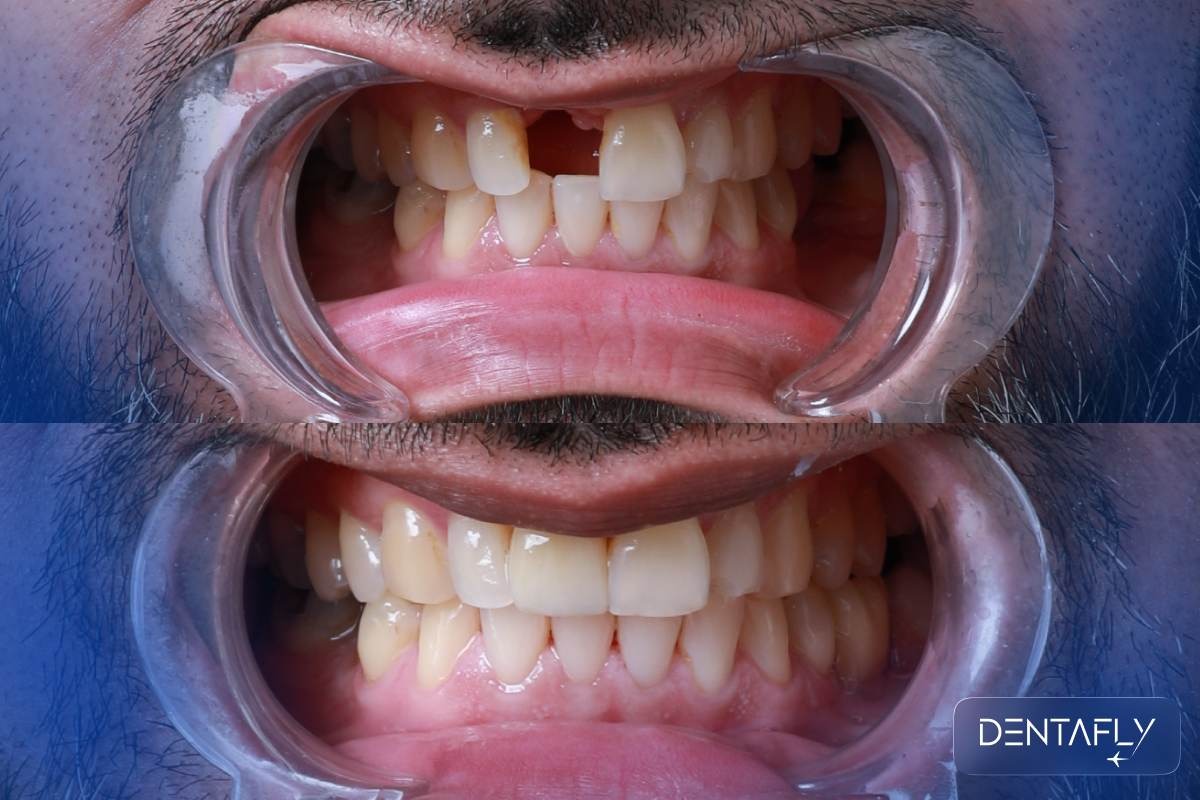
Losing a single tooth changes more than your smile. It shifts the way you chew, speak, and even how the bone in your jaw behaves over time. Most UK patients I speak with at our London consultations have already heard the standard suggestions: a partial denture, a bridge, or “just leave it for now.” None of these protect the bone underneath. None feel quite like a real tooth. And for many people, the private UK price tag of £2,000-£2,500 puts a fixed implant solution out of reach.
That is what makes Turkey worth a serious look. At Dentafly’s Antalya clinic, a premium single tooth implant starts at £400, fitted by maxillofacial surgeons using the same Straumann or Nobel Biocare brands you would find in Harley Street. Aftercare happens at our London clinic on Church Lane (NW9 8SN), so you are never left navigating post-op questions alone. For a wider view of how Turkey compares for full implant treatment, see our complete dental implants in Turkey guide.
What is a Single Tooth Implant?
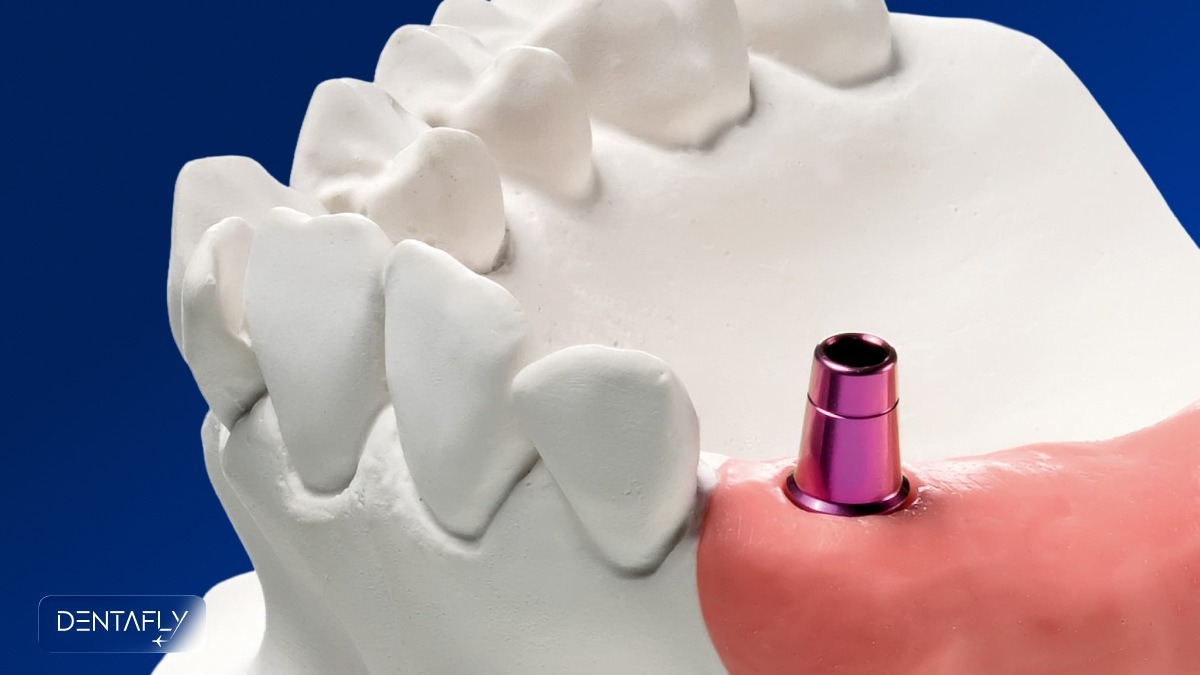
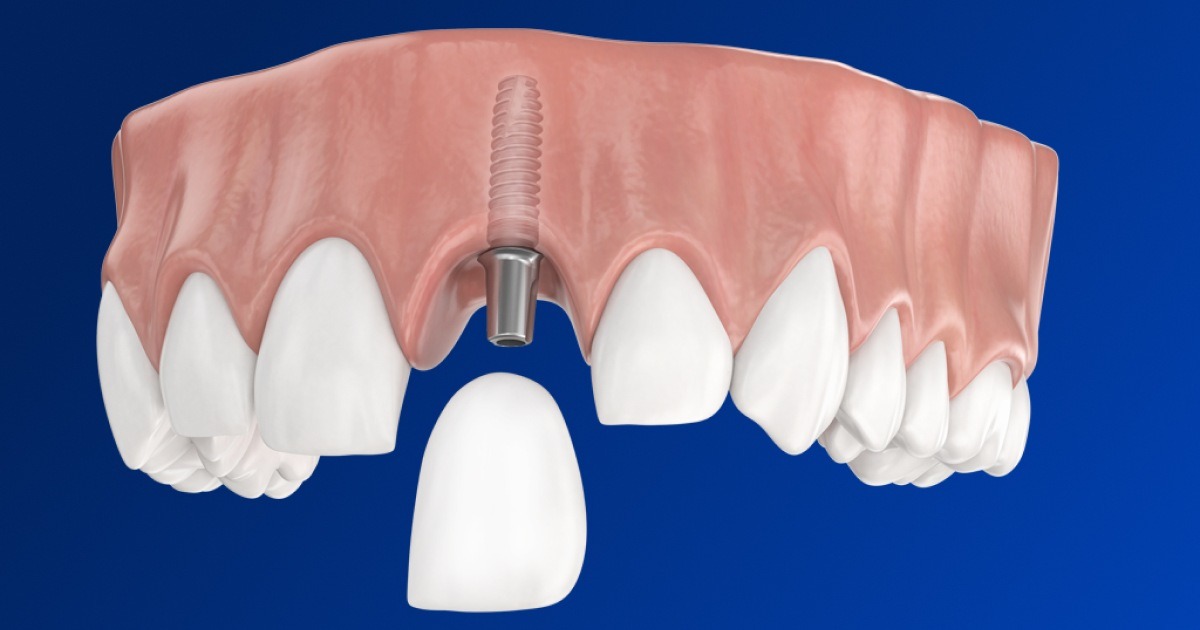
A single tooth implant is, at its core, an artificial tooth root. It consists of three components working together: the implant fixture (a small titanium post placed into the jawbone), the abutment (a connector that sits at gum level), and the crown (the visible white portion that looks and functions like a natural tooth).
What separates an implant from older solutions is that it integrates with living bone. The titanium surface, treated with chemistry that varies between brands (SLActive for Straumann, TiUnite for Nobel Biocare, NanoTite for others), encourages osteoblast cells to grow directly onto the metal. This bond is called osseointegration, and once complete, the implant is mechanically locked into the bone in a way that no other dental restoration can match.
The first successful titanium implant was placed by Per-Ingvar Brånemark in Sweden in 1965. The patient kept that implant functional for over 40 years. Modern designs have refined the geometry and surface treatment, but the core principle has not changed since then.
Why Choose a Single Implant Over Alternatives?
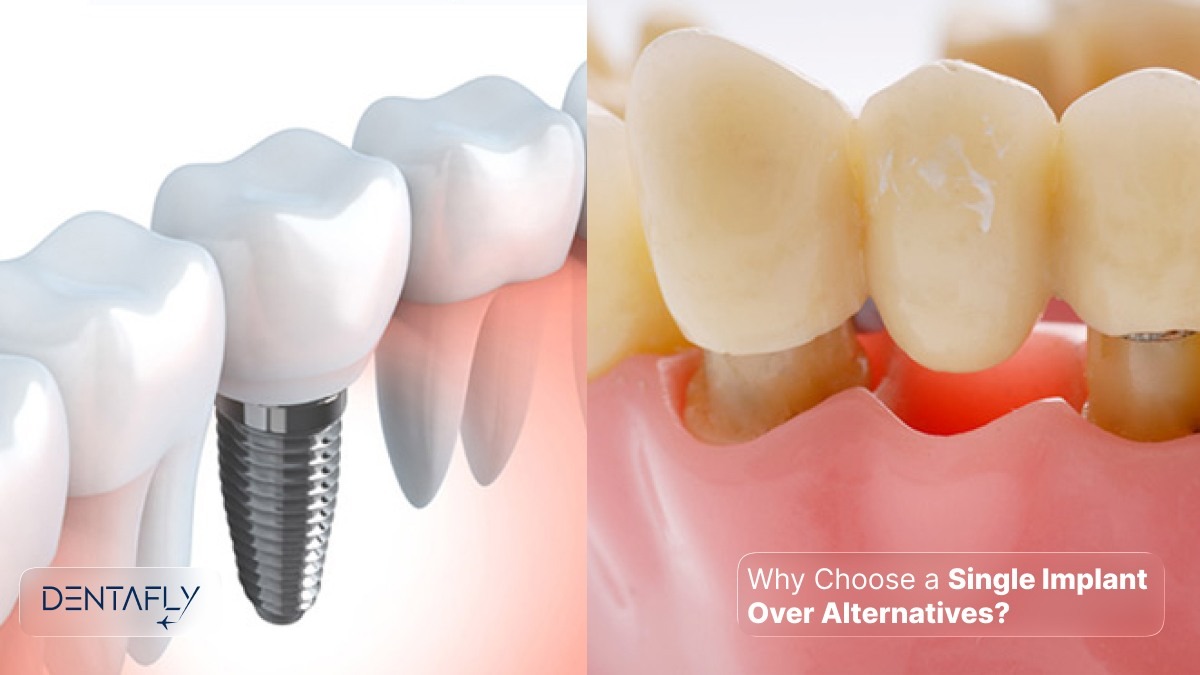
If you have lost a single tooth, three options exist. Each has trade-offs.
1. Single tooth implant (Recommended in most cases)
The implant replaces only the missing tooth. Adjacent teeth stay untouched. Bone is preserved because the titanium fixture transmits chewing forces into the jawbone, mimicking a natural root.
2. Tooth-supported fixed bridge
A bridge requires grinding down the two healthy teeth on either side of the gap. These reduced teeth become anchors holding a connected three-unit prosthesis. The downside is significant: those two adjacent teeth, which may have been completely healthy, lose 60-70% of their natural structure forever. Within 5-10 years, the bone underneath the bridge resorbs because nothing stimulates it.
3. Removable partial denture
A clip-on plastic prosthesis with a metal framework. It is the cheapest option but the least comfortable. It moves slightly while eating, requires removal at night, and accelerates bone loss in the same way as a full denture would.
In our Antalya clinic, around 70% of patients who initially come in asking about a bridge end up choosing a single implant once they see the long-term comparison. The decision usually comes down to one question: would you damage two healthy teeth to fix one missing tooth? Most people, given the choice, say no.
Implant & Digital Workflow Specialist, Dentafly
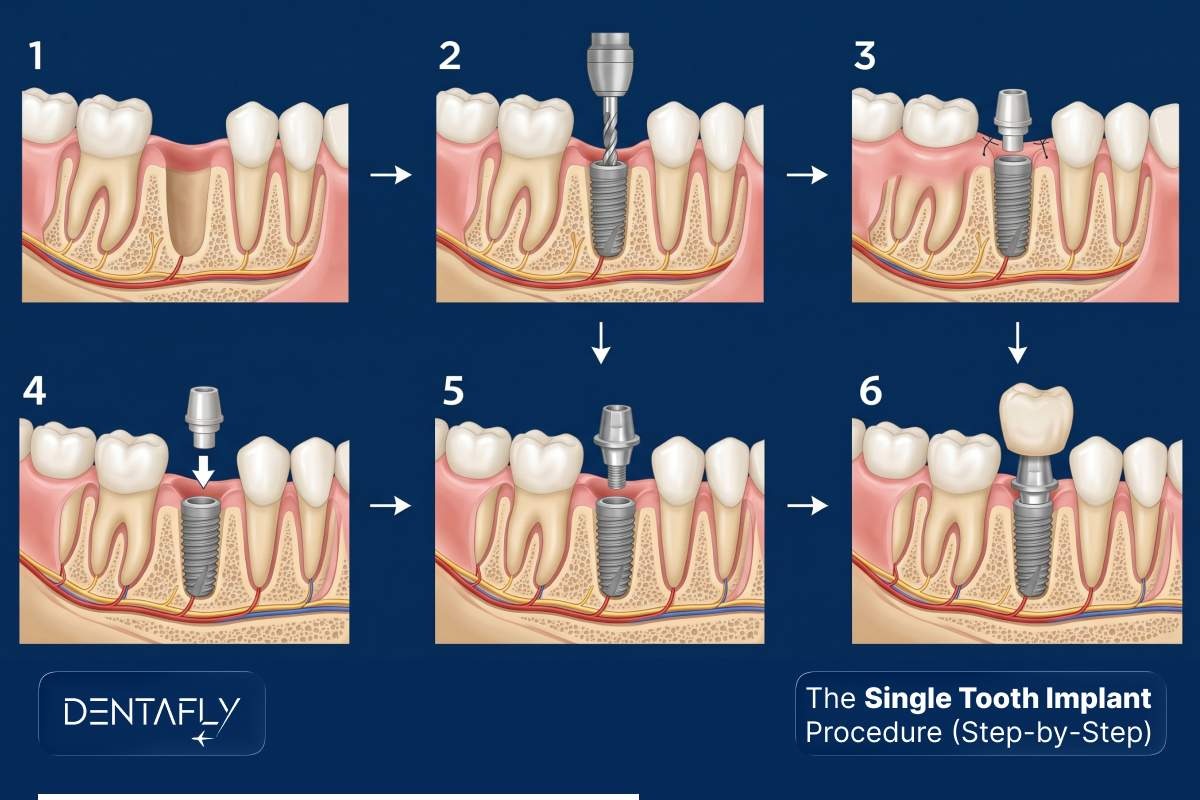
The Single Tooth Implant Procedure (Step-by-Step)
Stage 1: Diagnostic phase (Day 1)
You arrive at our Antalya clinic for a full diagnostic workup. We perform a 3D Cone Beam CT (CBCT) scan, which gives a millimeter-precise map of your bone density (graded D1 to D4), available bone height and width, the position of the inferior alveolar nerve, and the floor of the maxillary sinus if relevant. This data feeds directly into the surgical plan.
Stage 2: Surgical placement (Day 2)
Under local anesthesia, the surgeon makes a small incision in the gum, reflects a flap, and uses a sequence of progressively wider drills to prepare the osteotomy. The implant is then torqued into place. We measure primary stability using ISQ (Implant Stability Quotient) values via resonance frequency analysis (RFA). An ISQ above 70 indicates excellent stability and may permit immediate loading. Below 60 signals we should wait the full healing period.
Stage 3: Osseointegration (3-6 months)
This phase happens at home, mostly in the UK. New bone cells migrate onto the implant surface and form a direct mechanical bond. During this time you can wear a temporary tooth-shaped bonded restoration (Maryland bridge) or a clip-on flipper if the gap is visible. You attend monthly check-ups at our London clinic.
Stage 4: Abutment connection (back in Antalya)
After confirming integration with a follow-up CBCT, we attach the abutment. This is the connector piece that links the buried implant to the future crown. Some implant systems (one-stage protocols) skip this as a separate step.
Stage 5: Crown design (Digital impression)
Our in-house digital lab uses an iTero scanner to capture a 3D digital impression of your mouth. The crown is designed using CAD software, milled from a zirconia or e.Max ceramic block, and color-matched to your adjacent teeth using shade analysis under controlled lighting.
Stage 6: Crown placement and bite adjustment
The crown is cemented or screwed onto the abutment. The surgeon checks your bite using articulating paper and adjusts contact points with a fine bur. Final polish, photographs, and you walk out with a fully restored tooth.
For me, the most overlooked step is the bite adjustment at the end. Patients sometimes leave with the crown sitting slightly high, which puts uneven force on the implant and can cause problems years later. We use digital occlusion analysis to verify the contact pattern matches the rest of the dentition before the patient leaves the chair.
Prosthodontist, Ph.D. Ankara University, Dentafly
Best Implant Brands for Single Tooth Cases
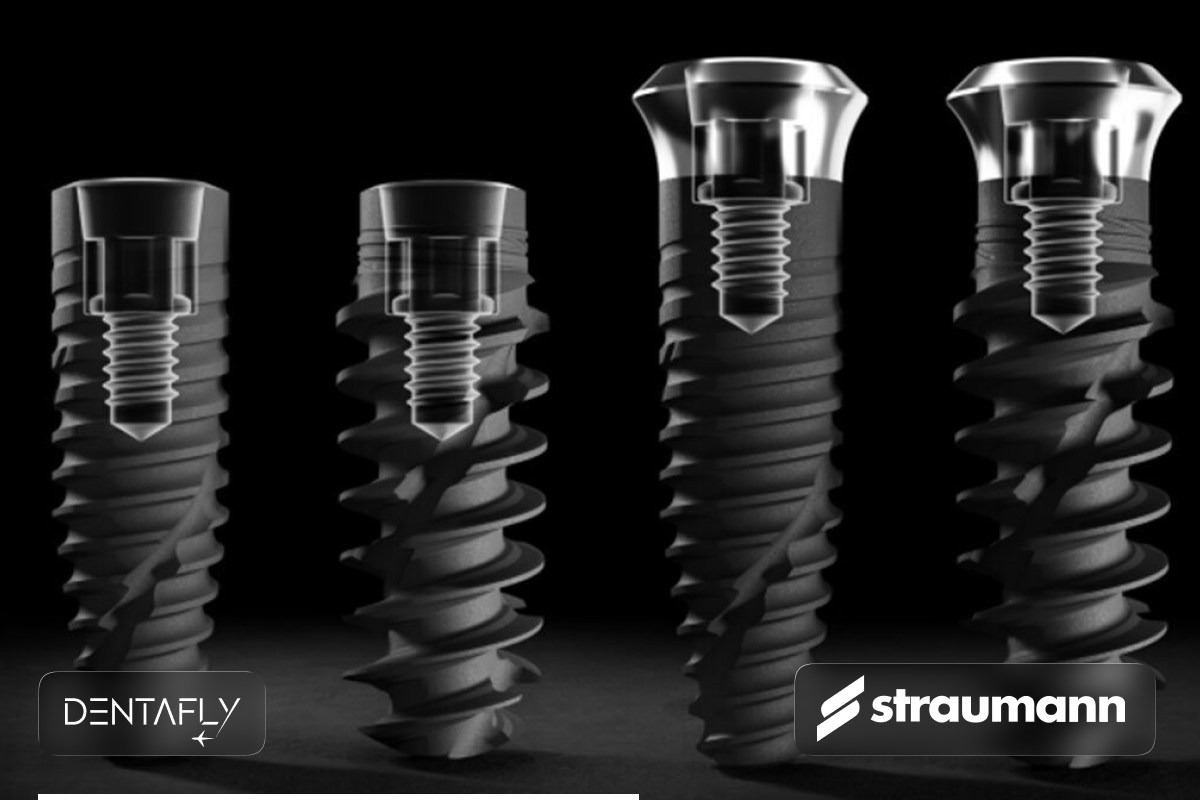
Not all implants behave the same way. Differences in surface treatment, thread design, and connection geometry affect both healing speed and long-term performance. We stock four brands and choose based on your specific case.
| Brand | Origin | Surface | Best For | Dentafly Cost | UK Equivalent |
|---|---|---|---|---|---|
| Straumann | Switzerland | SLActive | Diabetic patients, immediate loading, premium aesthetics | £750-£850 | £2,400-£2,800 |
| Nobel Biocare | Sweden/Switzerland | TiUnite | Front teeth, complex anatomy, all-on-x | £700-£800 | £2,200-£2,600 |
| Hiossen ETIII | South Korea | SA | Standard cases, healthy bone | £500-£600 | £1,800-£2,000 |
| Megagen AnyRidge | South Korea | XPEED | Soft bone (D3-D4), challenging anatomy | £400-£550 | £1,600-£1,900 |
The 2016 ITI Consensus Conference (International Team for Implantology) confirmed that hydrophilic surfaces like Straumann’s SLActive achieve secondary stability up to 2 weeks faster than conventional surfaces, particularly relevant in compromised bone. Source: Clinical Oral Implants Research, 2017.
For most healthy single-tooth cases, Hiossen offers the best price-quality balance. For visible front teeth or patients with diabetes, soft bone, or a history of failed implants, we typically recommend Straumann or Nobel Biocare. The Megagen AnyRidge thread profile excels in soft posterior bone (D3-D4), which is why it sees frequent use in upper jaw molar cases.
For deeper pricing across all brands and treatment combinations, see our dental implants cost guide.
Single Tooth Implant Cost: Turkey vs UK vs USA
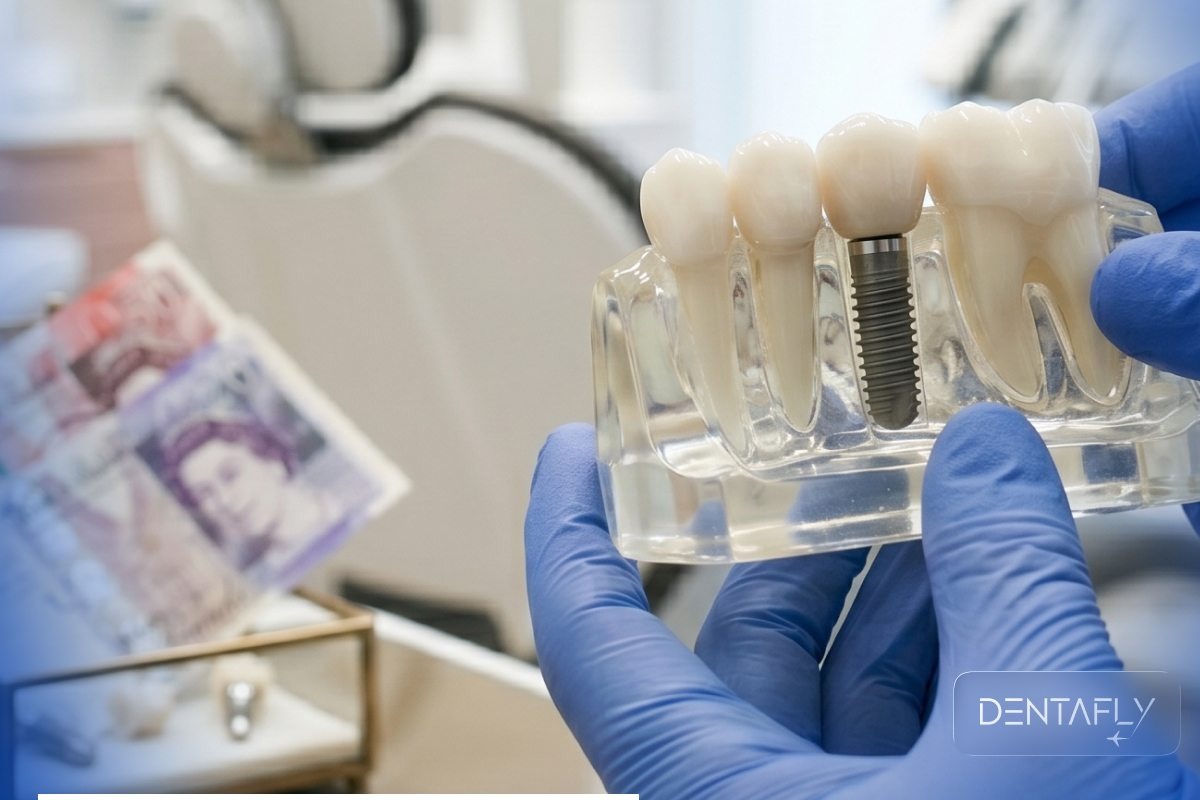
The cost gap is large enough that it usually shocks first-time enquirers. Three factors drive UK private pricing: clinic rent in London or major cities (£3,000-£8,000 per month), high lab fees from UK ceramic labs, and dentist salaries (£100,000-£250,000 annually). None of these factors relate to the implant itself.
| Treatment Component | UK Private (Avg) | USA Private (Avg) | Dentafly Turkey |
|---|---|---|---|
| Premium Implant + Standard Crown | £2,000-£2,500 | $3,100-$5,800 | £400-£700 |
| Premium Implant + Zirconia Crown | £2,500-£3,200 | $4,500-$7,200 | £700-£850 |
| 3D CBCT Scan | £200-£350 | $300-$500 | Included |
| Bone Graft (if needed) | £800-£1,400 | $1,200-$2,500 | £200-£400 |
| Total (no graft) | £2,200-£2,850 | $3,400-$6,300 | £400-£850 |
| Hidden costs | Consultation, X-rays separately | Insurance gaps | None – all inclusive |
The Dentafly all-inclusive package adds 4-5 star hotel accommodation in Antalya, VIP airport transfers, all medications, and UK aftercare follow-ups in London. None of these are charged separately. For US patients researching alternatives because Medicare excludes implant coverage, the math works out even more favorably given typical American pricing of $3,100-$5,800 per single implant according to American Dental Association fee surveys.
Worth noting: most UK private quotes do not include the consultation, X-ray, abutment, or even the crown in the headline price. When you sum all components, the gap widens further.
Success Rate: What Does the Research Actually Show?
A meta-analysis of 47 studies (n=12,847 single tooth implants, mean follow-up 8.3 years) published in the International Journal of Oral and Maxillofacial Implants reported a pooled 10-year cumulative survival rate of 96.4% (95% CI: 94.8-97.6%). Failure rates were highest within the first year (2.1%) and decreased substantially thereafter.
At Dentafly, we track every single implant we place. Across 4,200+ cases over the past 8 years, our recorded survival rate sits at 98.1%. We attribute the slightly above-average performance to three protocol decisions: (1) mandatory CBCT planning for every case, (2) ISQ measurement at placement to confirm primary stability, and (3) standardized 3-month osseointegration check before crown loading.
Failure, when it happens, almost always falls into one of three categories. Early failures (under 6 months) typically result from infection or insufficient primary stability. Mid-term failures (1-5 years) usually trace back to peri-implantitis, often driven by smoking or poor oral hygiene. Late failures (5+ years) most commonly involve crown fracture or screw loosening, which our lifetime warranty covers without additional charge.
When patients ask me about success rates, I show them the ISQ reading we take during placement. If the implant achieves primary stability above 70 N·cm and the patient is a non-smoker with adequate bone density, the statistical chance of failure within 10 years is under 2%. The numbers are reassuring once you see them in context.
Implantology & Periodontology Ph.D., Dentafly
Real UK Patient Results
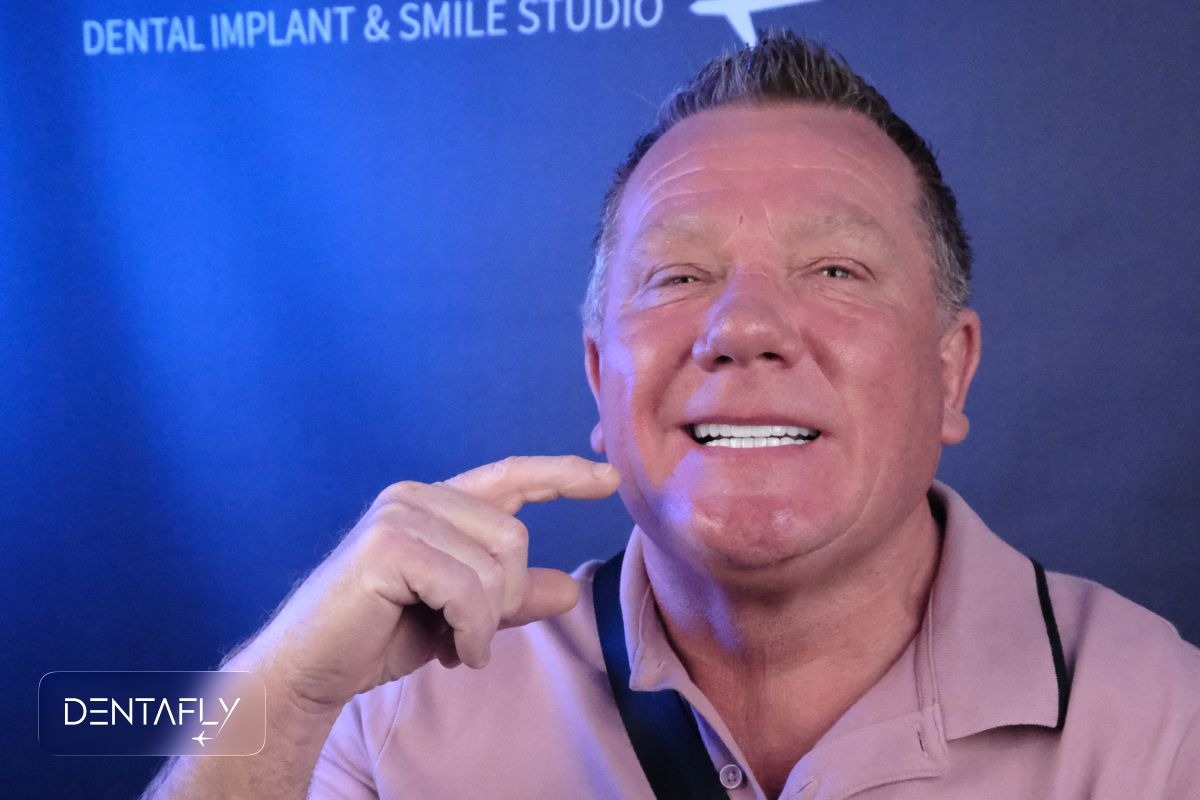
“Lost an upper front tooth from a cycling accident in 2023. My UK dentist quoted £2,800 for a single Straumann implant and crown. Paid £820 at Dentafly for the same brand. Two trips, six months in total. The crown matches my other teeth so well that even my hygienist couldn’t spot which one was the implant on her first check.”
“My back molar fractured beyond repair last year. The bridge option meant grinding down two healthy teeth I’d had filled but never had problems with. The Dentafly team showed me the CBCT and explained why a single implant would protect those teeth. Three days in Antalya for placement, four days for the crown. Felt comfortable from the second week.”
“Sixty-four years old when I lost a lower premolar. Local UK clinics quoted between £2,200 and £3,000. Found Dentafly through a friend who’d done All-on-4. The London clinic at NW9 8SN was the deciding factor; I knew I could pop in for any check-up without flying back to Turkey. Total cost for my Hiossen implant and zirconia crown: £570.”
“What surprised me was how digital the whole thing was. They scanned my mouth with an iTero machine instead of those gooey impression trays. Crown was milled in their on-site lab from a single block of zirconia. Two-week temporary, then the permanent went in with no adjustments needed.”
“As an American patient, I’d watched my Medicare Advantage plan cap dental at $1,500 a year, which wouldn’t even cover one implant in the States. Flew Houston-Istanbul-Antalya. The Straumann implant cost me $1,040 all-in, including hotel. Compared to the $4,200 quote from my home dentist in Texas, it was a no-brainer.”
UK Aftercare: Why It Changes Everything
Most overseas dental treatment ends the moment your flight home takes off. If something feels wrong three weeks later (a strange bite, a slight pain, a question about a temporary), you face the choice between flying back to Turkey or paying emergency UK private rates that can quickly erode your savings.
Dentafly takes a different approach. Our London clinic at 230 Church Lane, NW9 8SN handles all post-operative care for UK patients. The Week 1 check, the 3-month osseointegration scan, the 6-month integration confirmation, and ongoing yearly maintenance all happen on UK soil. If you have a question between visits, our UK coordinator answers within 24 hours via email or phone.
The clinic also handles warranty claims. If your implant or crown develops any issue covered by our lifetime warranty (which covers the fixture for life and the crown for 10 years), the replacement is arranged through the London clinic. You do not need to pay for return flights or accommodation in Turkey to use the warranty.
Are You a Good Candidate? (Honest Assessment)
Single tooth implants work for the majority of adults missing a tooth, but not for everyone. Here is what affects your candidacy.
Strong candidates
- Adequate bone volume (ridge width > 5mm, height > 8mm in the surgical site)
- Healthy gums with no untreated periodontal disease
- Non-smoker, or willing to quit for at least 4 weeks pre/post surgery
- Controlled medical conditions (diabetes is fine if HbA1c is below 7%)
- Reasonable expectations about the 3-6 month timeline
Cases requiring additional planning
- Bone loss greater than 30% of original ridge volume (may need bone graft first)
- Heavy bruxism (teeth grinding) without a night guard
- Recent oral cancer treatment with radiation therapy in the area
- Bisphosphonate medication for osteoporosis (requires individual review)
- Active smokers (failure rates rise to 6-8% versus 2% in non-smokers)
Generally not suitable
- Adolescents under 18 (jaw still growing)
- Uncontrolled diabetes (HbA1c above 9%)
- Active chemotherapy or recent radiation to head and neck
- Severe untreated periodontitis affecting adjacent teeth
The free X-ray review identifies which category you fall into. About 88% of UK patients who send us a panoramic X-ray qualify directly. Around 9% need a small bone graft first (which we can perform in the same treatment trip). The remaining 3% are referred to alternative solutions like All-on-4 or other tooth-supported options.
How the Process Works for UK Patients
Step 1: Send your X-ray (Free)
Email a recent panoramic X-ray or CBCT scan to our maxillofacial team. If you do not have one, any UK dentist can take a panoramic for £30-£60. Within 24 hours, we provide a treatment plan, exact pricing, and recommended timeline.
Step 2: Optional London consultation
Visit the Church Lane clinic to meet our UK coordinator face-to-face. We review your scan together, discuss brand options, and answer questions. Many patients find this in-person step reassuring before traveling.
Step 3: First trip to Antalya (3-4 days)
Direct 4-hour flights from London, Manchester, Edinburgh, Glasgow, or Birmingham. VIP transfers from the airport. Day 1 is diagnostic, Day 2 is implant placement, Day 3-4 is rest and post-op check before flying home.
Step 4: Healing in the UK (3-6 months)
Osseointegration happens at home. You wear a temporary tooth replacement and attend monthly check-ups at the London clinic. Most UK patients find this period easier than expected since there is no visible gap and no functional impairment.
Step 5: Second trip for crown (4-5 days)
Once integration is confirmed, return to Antalya for digital impressions, abutment placement, and crown fitting. The crown is milled in our on-site lab from zirconia or e.Max ceramic.
Step 6: Ongoing UK aftercare
All future check-ups, cleanings, X-rays, and warranty matters happen at the London clinic. You never need to fly to Turkey again unless you choose to.
For US Patients: Single Tooth Implants and Insurance Reality
American patients face an even tighter coverage situation. Original Medicare excludes dental implants entirely. Medicare Advantage (Part C) plans typically cap annual dental at $1,300-$2,000, which barely covers half of one implant given the American Dental Association’s reported average of $3,100-$5,800 per single tooth case. Most state Medicaid programs classify implants as elective and decline to fund them, with rare exceptions in California, Ohio, and West Virginia.
For US patients, the round-trip to Turkey works out as follows: a Straumann or Nobel Biocare single implant costs around $980-$1,070 at Dentafly. A typical round-trip Houston-Istanbul flight runs $700-$900 in shoulder season. A 4-night hotel stay in Antalya is around $300. Total: approximately $2,000-$2,300, including travel, for a treatment that would cost $4,200-$6,800 at home before any insurance contribution.
The same UK aftercare benefit does not apply to US patients geographically, but Dentafly’s Global Warranty is recognized by certified US dentists. Most local US dentists will perform routine cleanings, post-op checks, and even warranty replacements with a referral letter from our team.
Frequently Asked Questions
How much does a single tooth implant cost in Turkey?
How long does the procedure take?
What is the success rate?
Is a single tooth implant better than a bridge?
Will my single tooth implant look natural?
Do I need bone grafting first?
How many days do I need in Turkey?
Can I get a same-day single tooth implant?
What implant brands do you use?
What happens if my implant fails after I return home?
Is the procedure painful?
How does the free X-ray review work?
References & Studies
- Brånemark, P-I. et al. (1965, ongoing follow-ups): Original osseointegrated implant case series. Journal of Periodontology and subsequent journals.
- ITI Consensus Conference (2016): Surface treatments and primary stability protocols. Clinical Oral Implants Research, 2017.
- Meta-analysis (2023): 10-year survival of single tooth implants, n=12,847. International Journal of Oral and Maxillofacial Implants.
- American Dental Association: 2024 Survey of Dental Fees, single implant pricing $3,100-$5,800.
- NHS England: Restorative Dentistry-UK 2019 guidelines on implant funding eligibility.
- AACI Accreditation: Program Number C477-2025-MSC-TR (valid through 16 November 2028).
- ISO 9001:2015: Quality Management Systems Certification for Medical and Dental Services.
- Centers for Medicare and Medicaid Services: Non-Covered Dental Services Classification, 2026.
Related Reading
- Complete Dental Implants in Turkey Guide: Pillar overview of all implant types, brands, and procedures
- Dental Implant Costs in Turkey: Full pricing breakdown across all brands
- All-on-4 Dental Implants: Full jaw restoration with four implants
- All-on-6 Dental Implants: Maximum-stability full-arch solution
- Bone Grafting in Turkey: When you need foundation work first
- NHS Dental Implant Alternative: Why UK patients choose Turkey
- Meet Our Dental Team: Specialists including Dt. Görkem Buğra Ceyhan and Assoc. Prof. Dt. Gülen Kamak
- Patient Reviews: 1,027+ Trustpilot stories from real Dentafly patients
- Is Turkey Safe for Implants?: Independent safety review
- Free X-Ray Review: Get a personalised quote in 24 hours
Ready to Replace That Missing Tooth?
Send us your X-ray for a no-obligation treatment plan within 24 hours. Free assessment, transparent pricing, UK aftercare included.