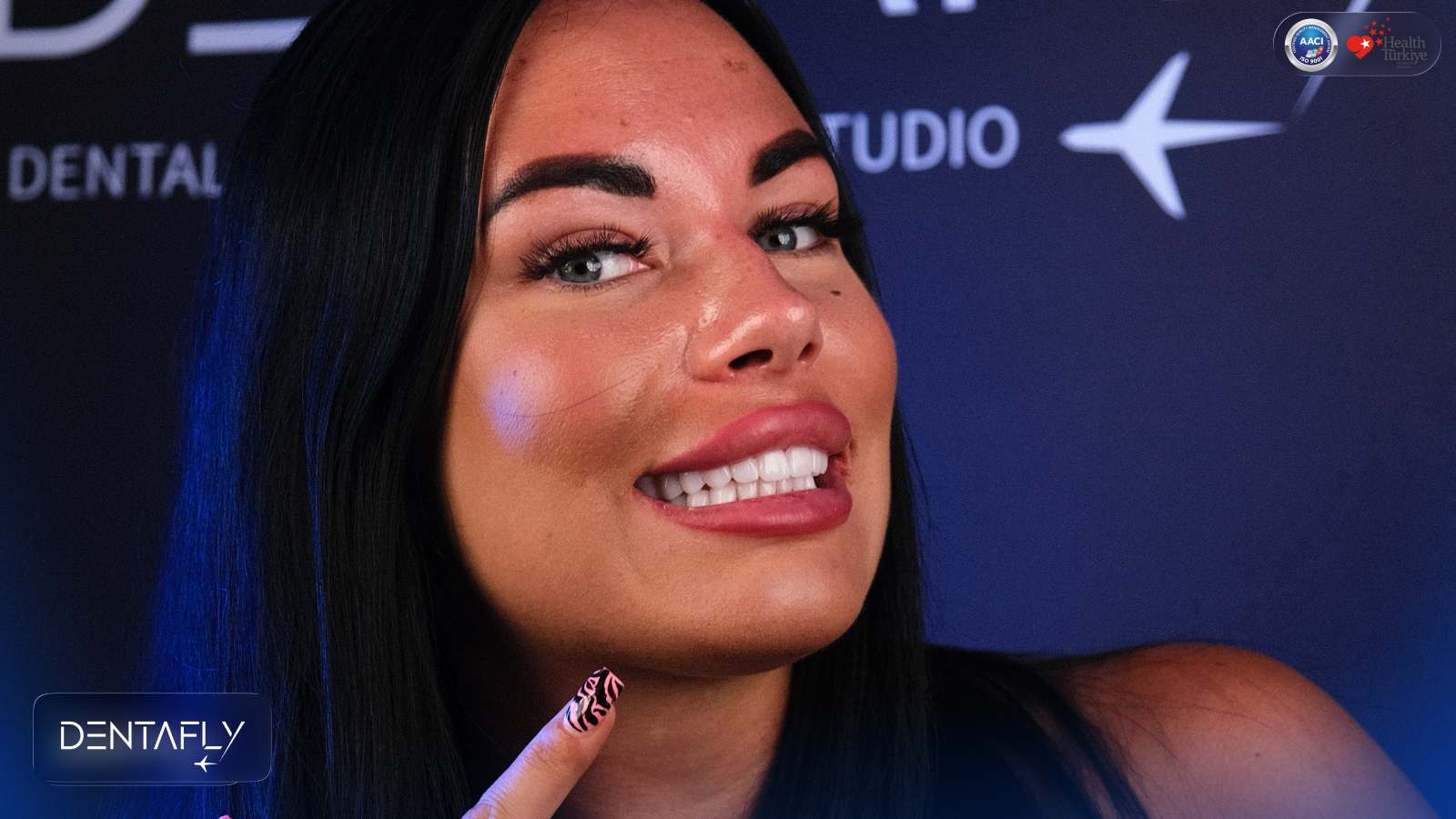
A Hollywood smile uses brighter shades (BL1 to BL3) and opaque zirconia ceramics to deliver a uniformly bright, transformative result. A natural smile makeover uses VITA shades (A1, A2, B1) and translucent E.max ceramics to deliver a refined brighter version of your existing smile. Both produce 10-15+ year longevity at Dentafly; the right choice depends on your facial palette, profession, and personal preference, decided during Digital Smile Design before any tooth is prepared.
This decision guide compares the two approaches across shade selection, ceramic materials, longevity, reversibility, cost, and the patient profiles each option suits best. For the broader treatment context, see our complete smile makeover Turkey guide.
What Is the Difference Between Hollywood Smile and Natural Smile Makeover?
At the technical level the two approaches share more than they differ. Both use bonded ceramic restorations on prepared teeth; both can include veneers, crowns, or a combination; and both follow the same Digital Smile Design workflow during the planning phase. The differences are in the aesthetic targets set during shade selection and in the ceramic materials chosen to deliver those targets.
Defining the Hollywood smile
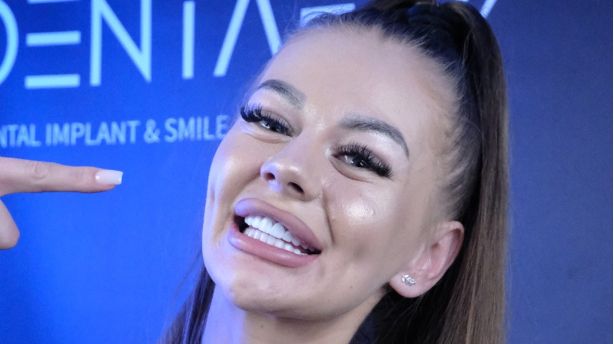
A Hollywood smile produces a uniformly bright, opaque result across the visible smile zone. Shade targets typically sit between BL1 and BL3 on the bleach scale, the brightest range available on standard shade guides. The ceramic of choice is most often zirconia, valued for its strength and opacity. The look reads as “perfectly white” rather than as “a brighter version of your natural teeth.” It is the smile aesthetic associated with red-carpet photography, stage performance, and on-camera professional contexts.
Defining the natural smile makeover
A natural smile makeover delivers a brighter, more uniform smile while keeping the result within the spectrum a viewer might attribute to good genetics and consistent hygiene. Shade targets sit within the VITA scale (most commonly A1, A2, or B1), which represents the colours found in healthy adult enamel. The ceramic of choice is most often E.max (lithium disilicate), valued for its translucency. The light transmission through E.max produces the optical depth that natural enamel has, which is why the result avoids the “block of porcelain” appearance.
The four visual differences at a glance
When looking at two patients side by side, four differences become visible:
- Shade brightness: Hollywood reads as bright white; natural reads as a healthy bright shade
- Translucency: Hollywood is opaque; natural transmits light through the tooth edges
- Shade variation between teeth: Hollywood has uniform colour across all teeth; natural carries slight individual variation that mimics real enamel
- Surface texture: Hollywood is typically smoother and more uniform; natural retains subtle surface texture (perikymata) that catches light differently
Side-by-Side Comparison Table
The Hollywood smile vs natural smile makeover comparison below covers the 11 variables that matter most during decision-making. This table is the most-referenced section of the guide and worth bookmarking before your DSD consultation.
| Variable | Hollywood Smile | Natural Smile Makeover |
|---|---|---|
| Shade target | BL1, BL2, BL3 (bleach range) | A1, A2, B1 (VITA range) |
| Default material | Zirconia crowns | E.max veneers |
| Translucency | Opaque to slightly translucent | High translucency |
| Shade uniformity | Uniform across all teeth | Subtle variation between adjacent teeth |
| Visual impact | Dramatic, obvious change | Noticeable but ambiguous (could be natural) |
| Typical preparation | Full coverage (1-1.5mm enamel) | Minimal (0.3-0.7mm enamel) |
| Reversibility | Not reversible | Not reversible, but more structure preserved |
| Longevity | 10-15+ years | 10-15+ years |
| Dentafly price (per tooth) | From £140 (classic zirconia) | From £230 (E.max veneer) |
| Best for | Professional on-camera, dramatic change | Office, social, age-appropriate refinement |
| “Turkey teeth” risk | Higher if shade is over-selected | Very low |
Get Your Personalised Shade Plan
Send your smile photographs and we’ll return a written plan with proposed shade, ceramic material, and Day 1 DSD preview schedule within 24 hours.
Get Your Free Quote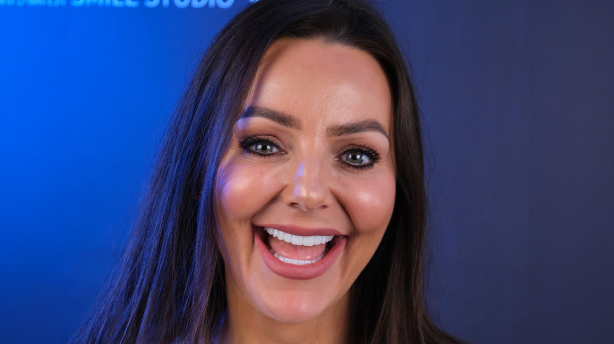

Zirconium Crowns 10 Upper 10 Bottom
Zirconium Crowns 10+10
Apply for Dental Finance
e-max Veneers 8+8
e-max Veneers 8+8
Apply for Dental Finance
All-on-4 Cad/Cam
Apply for Dental Finance
All-on-6 Cad/Cam
Apply for Dental Finance
Composite Bonding 10+10
Apply for Dental Finance
Who Should Choose a Hollywood Smile?
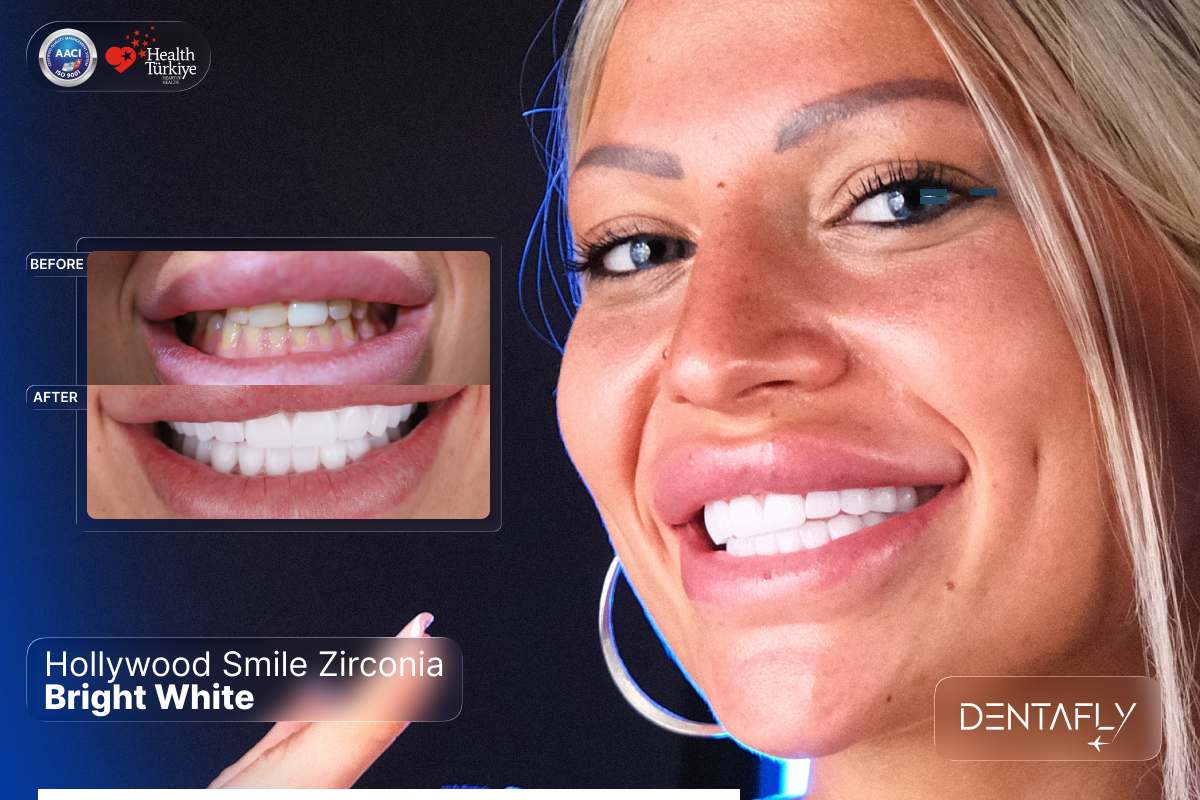
The Hollywood smile is the right answer for a specific subset of UK patients whose lifestyle, profession, or personal aesthetic preference favours dramatic change over subtle refinement. The five patient profiles below cover the situations where Hollywood-style results consistently produce satisfaction at the 6-month and 12-month review.
1. On-camera and stage professionals
DJs, broadcasters, theatre performers, drag artists, and presenters work under stage lighting that washes out natural shades. A VITA A1 shade that reads as “noticeably bright” under daylight reads as “average teeth” under 5,600K stage lighting. Hollywood-bright BL1 shades survive the lighting compression and read on camera as intended.
2. Heavy discolouration that won’t lift with whitening
Tetracycline staining, dead nerves, severe fluorosis, or tooth structure that has been discoloured for decades may not respond to professional whitening. In these cases the choice is not Hollywood vs natural; it is whether to mask the underlying colour entirely or to settle for a partial improvement. Opaque zirconia in BL2 or BL3 successfully masks colour that translucent E.max cannot.
3. Patients who want unambiguous transformation
Some patients arrive specifically because they want everyone to notice the change. The aesthetic goal is not “you look refreshed” but “you have new teeth.” Honest practice respects this choice. A patient who completes their treatment, looks in the mirror, and thinks “this is exactly what I wanted” achieves a successful outcome regardless of how subtle or dramatic the change is.
4. Severe wear, multiple chips, and short teeth
Where existing teeth are heavily worn or shortened by years of grinding, the Hollywood approach often involves both colour change and significant length restoration. Zirconia crowns can lengthen teeth by 2-4mm to restore youthful proportions, and the dramatic shape change pairs naturally with a brighter shade target.
5. Patients seeking maximum durability
Zirconia is the strongest ceramic option in contemporary dentistry. For patients with heavy bite forces, bruxism (with a nightguard), or any indication that mechanical durability matters more than translucent aesthetics, zirconia delivers the long-term mechanical reliability that lithium disilicate cannot quite match in the posterior zone.
Discuss Your Hollywood Smile Option
Send a photograph and we’ll show you a Digital Smile Design preview of the proposed Hollywood result before you commit to anything.
Request Your DSD Preview
Zirconium Crowns 10 Upper 10 Bottom
Zirconium Crowns 10+10
Apply for Dental Finance
e-max Veneers 8+8
e-max Veneers 8+8
Apply for Dental Finance
All-on-4 Cad/Cam
Apply for Dental Finance
All-on-6 Cad/Cam
Apply for Dental Finance
Composite Bonding 10+10
Apply for Dental Finance
Who Should Choose a Natural Smile Makeover?
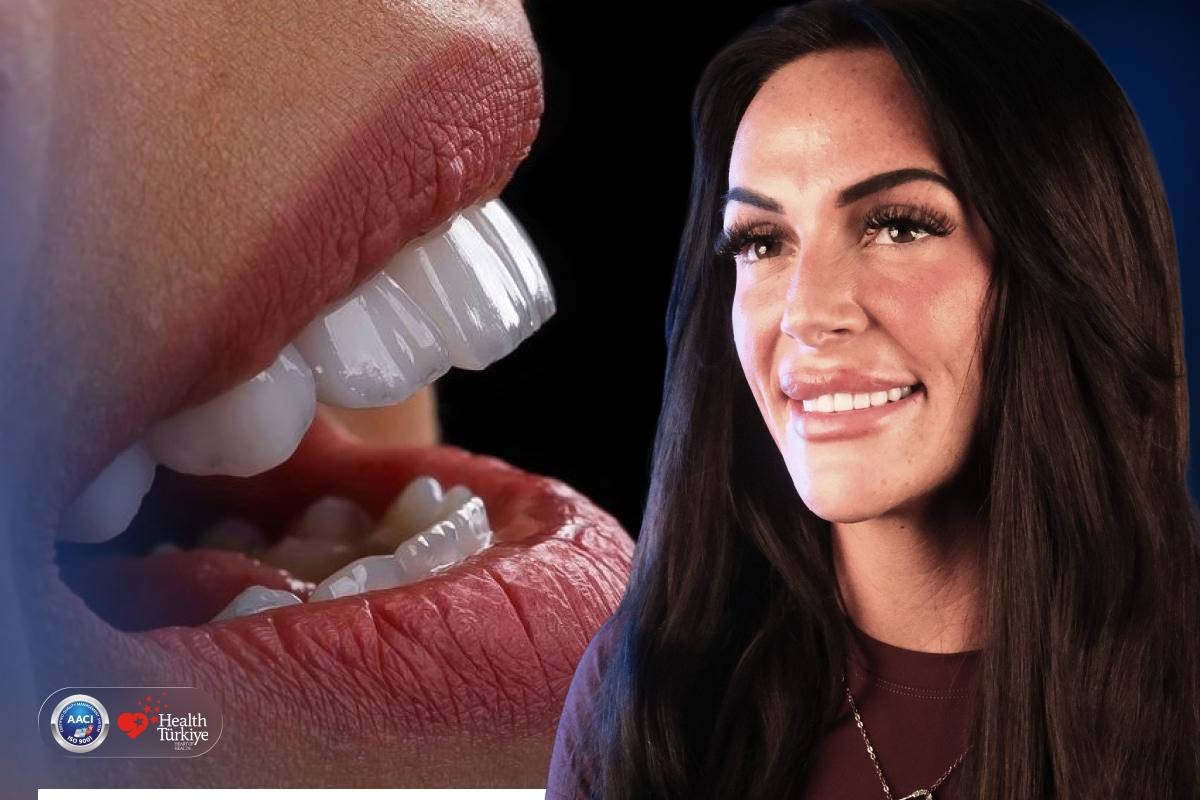
The natural smile makeover is the right answer for the majority of UK patients who arrive at cosmetic consultation. The five patient profiles below cover the situations where natural-shade selection consistently delivers the highest long-term satisfaction.
1. Office and professional environments
Lawyers, doctors, accountants, executives, and corporate consultants work in settings where appearing “polished and refined” matters more than appearing “transformed.” Natural-shade smile makeovers signal good self-care without inviting the question “have you had your teeth done.” For most UK professional contexts, this is the safer default.
2. Patients over 40 seeking age-appropriate refinement
Skin tone, eye colour, and overall facial appearance change with age. A BL1 shade that looks deliberate on a 25-year-old can look discordant on a 55-year-old whose skin and hair carry warmer tones. Natural VITA shades (A1 or A2) match the broader facial palette and avoid the “obviously dental” effect that ageing skin amplifies.
3. Patients worried about the “Turkey teeth” look
The most common reason UK patients ask about natural smile makeovers is that they have seen unflattering examples on social media and want to avoid the same outcome. The natural approach with E.max veneers and VITA shade selection is the direct answer to this concern. Patients who arrive with this worry are almost always best served by the natural option.
4. Existing healthy teeth that need refinement, not replacement
Where the underlying teeth are structurally sound and the cosmetic concerns are limited to mild discolouration, minor chips, small gaps, or slight crowding, E.max veneers preserve significantly more natural tooth structure than zirconia crowns. The result feels like a refined version of the original smile rather than a substitution for it.
5. Patients with high facial expressiveness
Some patients smile broadly and frequently in daily life; others smile more reservedly. For the first group, a dramatic Hollywood result can dominate the face and read as “all teeth” in expressive moments. The natural approach with subtle individual shade variation between teeth produces a smile that supports the facial expression rather than overpowering it.
The “Turkey Teeth” Reputation and Why Shade Choice Matters
The phrase “Turkey teeth” that circulates on UK social media is not really about Turkey. It is about a specific aesthetic choice that produces a specific look, regardless of where the work is done. The same shade selection delivered by a London cosmetic dentist would produce the same reaction. Three factors drive the unflattering appearance:
1. Shade target set too bright for the patient’s facial palette
The single biggest cause is BL1 or brighter selected without considering skin tone, eye colour, or age. A shade that suits a 22-year-old fashion influencer does not automatically suit a 45-year-old accountant. Honest shade consultation matches the target to the face, not to the patient’s imagined ideal.
2. Opaque ceramic on every tooth
Uniform opacity across 16 or 20 teeth removes the natural light dynamics of healthy enamel. The result reads as obviously dental because real enamel transmits and reflects light differently from tooth to tooth. Translucent E.max veneers preserve this optical complexity; opaque zirconia in bright shades does not.
3. Uniform shade and shape across all visible teeth
Real teeth are not identical. Subtle variation in shade, length, and edge contour is what reads as natural. When every restoration is fabricated to identical specifications, the smile loses the visual cues that signal “natural teeth” and gains the cues that signal “uniform restorations.”
BL1 vs VITA A2: Understanding the Shade Spectrum
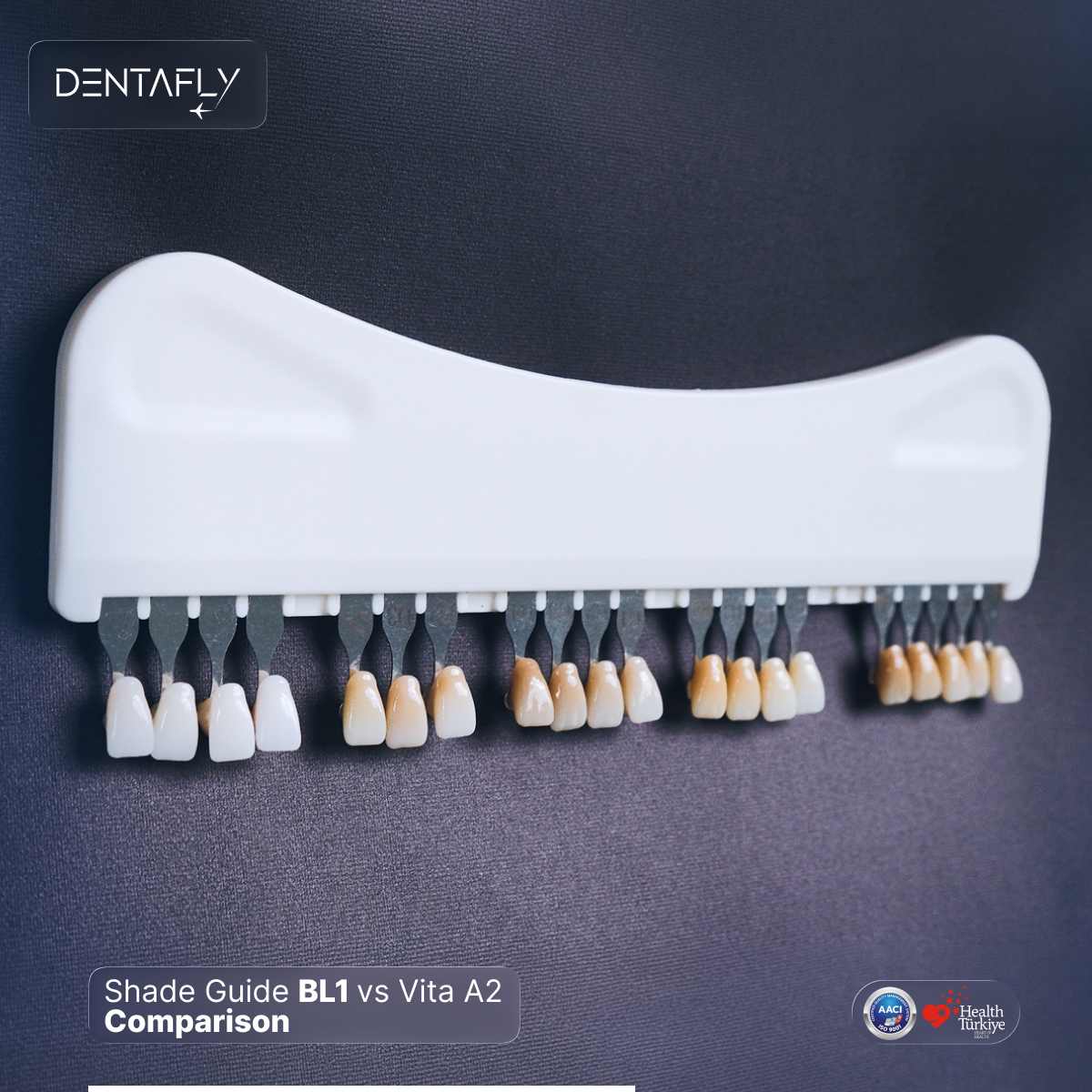
Understanding the shade vocabulary helps the decision feel less arbitrary and more informed. There are two scales clinicians use:
The VITA scale: natural tooth colours
The VITA Classical shade guide covers 16 shades organised into four hue families: A (reddish-brown), B (reddish-yellow), C (greyish), and D (reddish-grey). Numbers from 1 to 4 indicate intensity within each family. A1 represents the lightest VITA shade and approximates the brightest naturally occurring adult enamel. Most UK patients with healthy teeth fall between A2 and B2 on this scale.
The BL bleach scale: brighter than natural
The BL scale was developed because the VITA range did not include the bright whites cosmetic patients increasingly requested. BL4 is just above A1; BL1 is the brightest end of the scale and lies clearly above any naturally occurring tooth colour. The transition from A1 to BL1 is the practical line between “natural” and “Hollywood” aesthetic targets.
How Dentafly Selects the Right Style on Day 1
Shade selection at our Antalya clinic follows a four-step protocol used in every smile makeover consultation, Hollywood or natural. The Digital Smile Design step is the safety net: if the proposed shade does not look right on screen, it does not look right in real life, and the conversation continues until alignment is reached.
- VITA shade mapping under daylight-balanced 5,500K clinical lighting to identify the patient’s current natural shade and establish the baseline
- Skin, eye, and hair tone assessment to determine the natural shade range that suits the facial palette
- Patient preference discussion mapping lifestyle, profession, and personal goals against the Hollywood vs natural framework
- Digital Smile Design preview overlaying the proposed shade and shape on the patient’s photograph for visual confirmation before any tooth preparation
This protocol exists for one reason: the worst outcome in cosmetic dentistry is a patient committing to a shade they will regret six months later. The DSD preview gives an honest visual answer before the irreversible step begins.
12 Smile Styles: Finding Your Aesthetic Identity
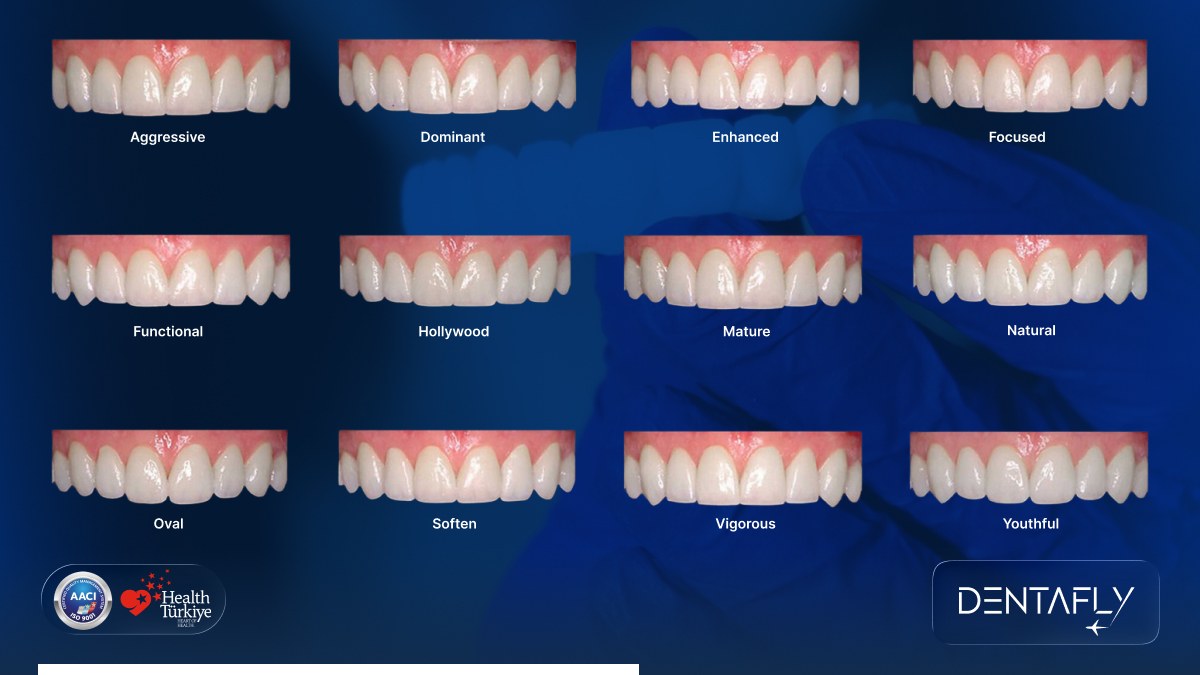
The Hollywood-vs-natural decision is the first layer; beneath it sits a more granular set of choices about smile character. Contemporary cosmetic dentistry recognises 12 broad smile styles, originally drawn from work by smile typology researchers and refined in clinical practice. While the names vary between authors, the principles below cover the categories that matter for UK patient decision-making.
The dominant five styles in UK patient cases
- Natural: proportionate, slight individual variation, soft edges (the default natural smile makeover)
- Youthful: rounded edges, slightly shorter visible teeth, soft enamel transitions (popular for patients 25-35)
- Mature: straighter incisal edges, slightly longer central teeth, sophisticated balance (popular for patients 45+)
- Hollywood: uniformly bright, slightly squared edges, dramatic but balanced (the default Hollywood smile)
- Soften: rounded corners, gentle transitions, especially suited to round or oval face shapes
The seven complementary styles
- Aggressive: bold central teeth, slight asymmetry, used for stage and on-camera contexts
- Dominant: proportionally larger central incisors for confident facial impact
- Enhanced: Hollywood-leaning but slightly translucent at edges
- Focused: sharper canines, defined lateral teeth, ideal for narrower faces
- Functional: prioritises bite function over aesthetics, used in restoration-heavy cases
- Oval: rounded contours throughout, exceptionally feminine appearance
- Vigorous: longer central teeth with slight projection, energetic facial impact
You do not need to know which style you want at first consultation. The DSD preview process tries the 2 or 3 styles that match your facial structure and lets you compare them on screen.
Materials Comparison: Zirconia vs E.max
In the Hollywood smile vs natural smile makeover discussion, material choice usually follows aesthetic target. Zirconia and E.max have different optical and mechanical properties that suit different visual goals.
Zirconia: the strong opaque ceramic
Zirconia is yttria-stabilised zirconium dioxide, a polycrystalline ceramic with exceptional mechanical strength. This strength makes it the standard choice for full-coverage crowns, posterior restorations, and Hollywood smile cases where opacity matters. Modern multilayer zirconia (such as Dentafly’s Straumann New Generation 3D 9 Multilayer at £200 per tooth or the Ivoclar Digital Monolithic Glass Ceramic at £210) offers improved translucency over traditional zirconia, narrowing the aesthetic gap with E.max for front-tooth applications.
E.max: the translucent strong ceramic
E.max is the brand name for IPS e.max, a lithium disilicate glass-ceramic. The crystal structure produces a translucency that mimics natural enamel while retaining strength acceptable for front-tooth applications. At Dentafly, E.max veneers and laminate veneers are £230 per tooth, and full-coverage E.max restorations are £210 per tooth. For natural smile makeovers, E.max remains the default because no other current ceramic matches its optical depth.
When each material is appropriate
Zirconia is preferred for:
- Hollywood smile cases with BL2-BL3 shade targets
- Heavy discolouration requiring opacity
- Posterior restorations under high bite force
- Full-coverage crowns on heavily damaged teeth
- Patients with documented bruxism (with nightguard)
E.max is preferred for:
- Natural smile makeover cases with VITA shade targets
- Patients prioritising translucency and optical depth
- Minimally invasive veneer preparations
- Healthy tooth structure that doesn’t require full coverage
- Front-tooth aesthetic detail where light dynamics matter
Hollywood Smile vs Natural Smile Makeover Cost
Cost differences are driven by material rather than by aesthetic style. The Dentafly published prices below give the like-for-like comparison.
| Material | Style application | Dentafly price (per tooth) |
|---|---|---|
| Classic Zirconia Crown | Hollywood smile default | £140 |
| Dentafly Crystal Zirconium Crowns | Hollywood premium | £175 |
| Straumann New Generation 3D 9 Multilayer Zirconium | Hollywood premium | £200 |
| Ivoclar Digital Monolithic Glass Ceramic Zirconium | Hollywood/hybrid premium | £210 |
| E.max Full Veneers | Natural smile default | £210 |
| E.max Veneers & Laminate Veneers | Natural premium | £230 |
| Porcelain Crowns | Hollywood entry level | £95 |
| Composite Bonding Per Tooth | Natural minimally invasive | £105 |
Indicative case totals at Dentafly
The figures below assume a typical UK patient choosing one or the other approach with the default material:
- 8-unit Hollywood smile with classic zirconia: £1,120 (£140 × 8)
- 8-unit natural smile makeover with E.max veneers: £1,840 (£230 × 8)
- 16-unit Hollywood smile (upper 8 + lower 8) with classic zirconia: £2,240
- 16-unit natural smile makeover with E.max: £3,680
- 20-unit full Hollywood with multilayer zirconia: £4,000
- 20-unit full natural with E.max premium: £4,600
For the broader cost context across all smile makeover treatments, see our complete Dentafly price list.
Flexible Dental Finance from £60.72/mo
UK patients can spread treatment across 6-60 months using our partner dental finance providers. A £3,680 16-unit E.max natural smile makeover runs from £72.86 per month on the Dentafly e-max 8+8 package finance plan, well inside typical UK household budgets.
Zirconium Crowns 10 Upper 10 Bottom
Zirconium Crowns 10+10
Apply for Dental Finance
e-max Veneers 8+8
e-max Veneers 8+8
Apply for Dental Finance
All-on-4 Cad/Cam
Apply for Dental Finance
All-on-6 Cad/Cam
Apply for Dental Finance
Composite Bonding 10+10
Apply for Dental Finance
Get Your Smile Plan in Writing
Send us your smile photographs and we’ll return a detailed Hollywood vs natural comparison plan in pounds sterling within 24 hours, with no obligation to book.
Get Your Free QuoteReversibility and Longevity
In the Hollywood smile vs natural smile makeover comparison, two questions come up in nearly every consultation: how reversible is each option, and how long does each option last? The answers shape long-term satisfaction more than most patients expect at Day 1.
Reversibility honestly compared
Neither option is fully reversible. Both involve permanent removal of some natural tooth structure. However, the amount removed differs significantly:
- E.max veneers typically require 0.3-0.7mm of enamel reduction on the visible surface, leaving the underlying dentine and the back of the tooth intact
- Zirconia crowns require 1-1.5mm reduction around the entire tooth, removing significantly more structure
- Composite bonding is the only fully reversible option (no tooth structure removed), though aesthetic results are less stable long-term
For UK patients, this matters most for the long-term consequence: if a restoration fails 15 years later and needs replacement, the natural smile makeover option leaves more tooth available for the next intervention.
Longevity comparison
Both zirconia and E.max deliver similar longevity at the 10-15+ year horizon with good oral hygiene and a stable bite. The variables that matter more than material choice are:
- Bite-force distribution (a nightguard is recommended for any patient with bruxism)
- Consistent professional hygiene (6-monthly minimum)
- Margin integrity maintained from initial placement
- Stable periodontal health around the restoration margins
A Cosmetic Dentist’s Perspective
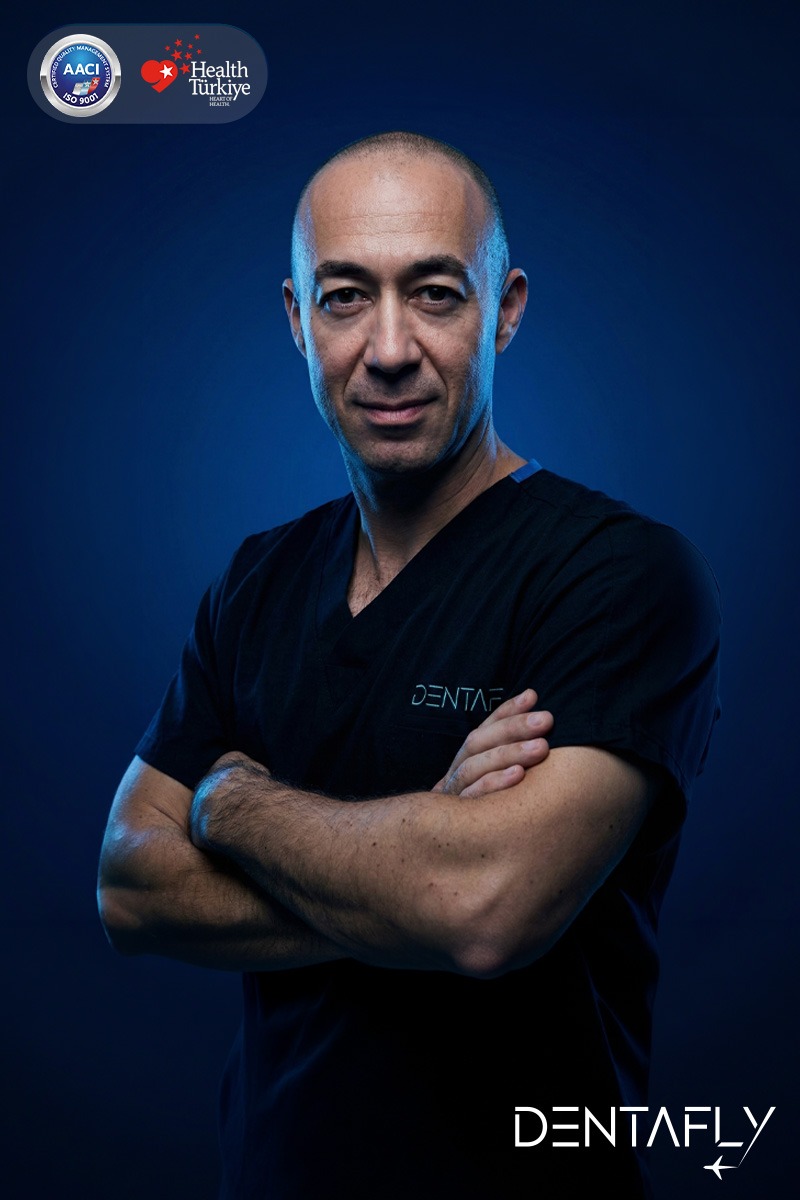
Beyond the technical specifications, the day-to-day reality of cosmetic dentistry is that two patients with identical clinical findings can want very different outcomes. The Hollywood smile vs natural smile makeover decision is rarely solved by the clinical chart alone. We asked Dr. Burak Gökdeniz to describe how he thinks about the choice.
The choice between a Hollywood smile and a natural smile makeover isn’t about which one is better; it’s about which one matches the patient sitting in the chair. My job is to ask the right questions on Day 1, show the proposed shade in Digital Smile Design before any tooth is prepared, and respect the answer the patient gives. The mistake we work hardest to avoid is choosing for them.
UK Patient Decision Framework
The Hollywood smile vs natural smile makeover decision often feels overwhelming at first consultation. Use the structured questions below to test your situation before booking a consultation. This is a self-assessment to narrow your shortlist; the final decision is made together with your consulting dentist during Day 1 DSD.
Five questions that point toward Hollywood
- Do you work on camera, on stage, or in a high-visibility public-facing role under bright lighting?
- Does your existing tooth colour resist whitening (tetracycline staining, internal discolouration)?
- Do you actively want people to notice the change rather than wonder if there was one?
- Are you under 35 and your skin tone supports a bright contrast?
- Are you treating heavily worn or shortened teeth that need length restoration alongside colour change?
If you answered yes to three or more, the Hollywood approach is worth serious consideration.
Five questions that point toward Natural
- Do you work in a corporate, professional, or formal setting where “polished” matters more than “transformed”?
- Are you over 40, with skin and hair colour in the warm-to-medium range?
- Have you specifically seen examples of “Turkey teeth” that worried you and want to avoid the same outcome?
- Are your existing teeth structurally healthy and the goal is refinement rather than replacement?
- Do you smile broadly and expressively, with high facial mobility around the mouth?
If you answered yes to three or more, the natural smile makeover is likely the right default for your case.
Get Your Decision Plan in Writing
Tell us about your situation and we’ll return a personalised Hollywood vs natural recommendation with proposed material, shade, and tooth count within 24 hours.
Get Your Free Quote
Zirconium Crowns 10 Upper 10 Bottom
Zirconium Crowns 10+10
Apply for Dental Finance
e-max Veneers 8+8
e-max Veneers 8+8
Apply for Dental Finance
All-on-4 Cad/Cam
Apply for Dental Finance
All-on-6 Cad/Cam
Apply for Dental Finance
Composite Bonding 10+10
Apply for Dental Finance
Real UK Patient Case: DJ Andrew’s Choice
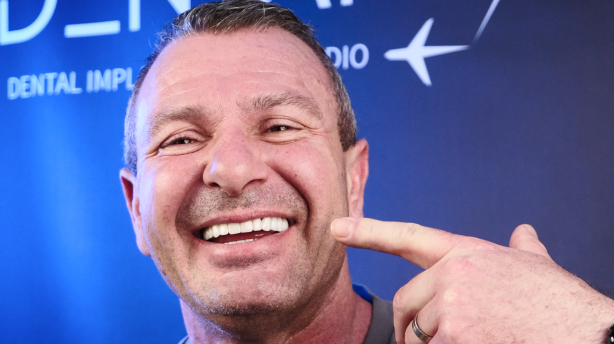
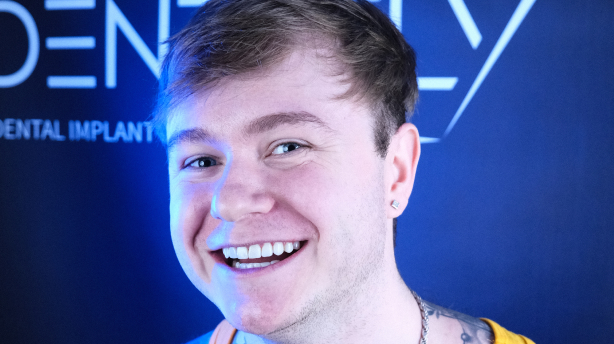
Andrew Weston, a London-based DJ, completed his smile makeover at Dentafly Antalya after a year of research. His case illustrates how occupational context shapes the Hollywood-vs-natural decision: as a working DJ performing under stage lighting, a brighter shade target suited his on-camera and on-stage appearance. The unedited interview covers his decision process and the day-to-day experience of treatment.
UK Aftercare for Both Smile Styles
Regardless of whether you choose Hollywood or natural, your 6-month aftercare review at our London NW9 8SN clinic follows the same structured protocol. The long-term outcome depends as much on maintenance as on the initial treatment choice. The review covers:
- Bite assessment to confirm restorations have settled into normal function
- Margin integrity check at every veneer or crown edge to detect microleakage early
- Periodontal review including bleeding-on-probing scores and pocket depth measurement
- Professional hygiene with restoration-safe instruments that do not scratch ceramic surfaces
- Photographic comparison against your post-treatment baseline to verify stability
- Warranty record activation on the UK side, so any future claim is processed at NW9 8SN
For the broader UK aftercare programme structure see our UK Aftercare at London NW9 8SN.
Frequently Asked Questions
Choice and Style Questions
What is the main difference between a Hollywood smile and a natural smile makeover?
Can I change my mind during the Antalya trip?
Will a Hollywood smile in Turkey look like Turkey teeth?
Cost and Materials Questions
Is a natural smile makeover more expensive than a Hollywood smile?
Can I combine zirconia and E.max in one smile makeover?
What if my existing teeth are dark and I want a natural look?
Recovery and Longevity Questions
Does a Hollywood smile last as long as a natural smile makeover?
Can I switch from a Hollywood smile to a natural look later?
What happens if I’m not happy with the result after returning to the UK?
UK Aftercare for Smile Makeover Patients at London NW9 8SN
Every Dentafly smile makeover patient, whether Hollywood or natural, receives a structured aftercare review at our London clinic six months after treatment. The visit covers bite assessment, margin integrity check at every restoration, periodontal review, professional hygiene with ceramic-safe instruments, photographic comparison against your post-treatment baseline, and warranty record activation on the UK side.
The NW9 8SN clinic is led by Dr. Merve Sezer Topcu, our UK Aftercare coordinator, with periodontal review available from Assoc. Prof. Dr. Gülen Kamak when escalation is required. All UK-based clinical work is performed by GDC-registered clinicians.
- 📍 230 Church Lane, London NW9 8SN
- 📞 +44 20 3302 9290
- ✉️ [email protected]
- 🕐 Mon-Fri 9:00-18:00, Sat 10:00-17:00
- 🚇 12 min from Colindale (Northern Line)
- 🚗 8 min from M1 Junction 2, free parking on-site
Dr. Burak Gökdeniz is the Head Dentist at Dentafly Antalya and the medical reviewer for every clinical article on this site. He holds a PhD in Prosthetic Dentistry from Ankara University Faculty of Dentistry, one of the leading dental academic institutions in Turkey, and has spent over two decades focused on CAD/CAM dentistry, Digital Smile Design, and the full smile makeover spectrum from minimally invasive E.max veneer cases to full-arch Hollywood smile transformations with multilayer zirconia.
His clinical signature is the Day 1 Digital Smile Design preview that gives patients a photographic answer before any tooth is prepared. His patient base is mostly UK-resident professionals planning the most personal cosmetic decision of their lives at a distance, so his consultation style prioritises slow, honest shade discussion over rushed commitments. Dr. Gökdeniz provides clinical handover for every UK smile makeover patient to the London NW9 8SN aftercare clinic before they fly home.